I got up at 7:00, with an alarm this time, and got dressed and ready to go, eating the two last black eggs before heading out.
As I stepped outside and began walking, I realized I was out with the commuters. I first stopped into Lawson for a small bottled smoothie to drink on the train and then descended the stairs to Kintetsu-Nippombashi Station. Not Nippombashi Station, mind you, 100 meters away. I had investigated and determined on my way home from Dotonbori last night that they are distinct stations.
I was early for the 7:51 train and perused the wall sign that displayed stations and routes and classes of train. Something called Limited Express required a special ticket. When a train approached earlier than the one I was waiting for, it was going my way and didn’t appear to be Limited Express, so I got on. This felt very daring of me, like I was testing the boundaries for a foreigner navigating transportation in Japan.
I rode the Kintetsu-Nara line the 40-minute journey to Nara. I sat next to a young girl reading through a schoolbook teaching her English. I considered asking if she wanted to practice with me, but that felt too forward and I decided against it.
I had first heard of Nara from a co-worker who lived in Japan for a year when she was in college, and I also encountered it in my pre-trip research. It’s a popular day trip from both Osaka and Kyoto, its largest draw probably being the tame deer roaming Nara Park that you can pet and feed crackers to. I mean, that was why *I* wanted to go! During my down time in Osaka yesterday, I’d come upon an Airbnb Experience consisting of a guided bicycling tour and decided to book it. Other than feeding the deer, I wasn’t sure what else I was going to do, and I really liked the idea of both biking and seeing parts of the town I probably wouldn’t see otherwise.
The meeting point at 9:00 was the Starbucks at JR Nara Station, about a 10-minute walk from Kintetsu-Nara Station where I’d disembarked. I had loaded the walking directions on Google Maps, which was good because for some reason I wasn’t getting any cellular signal in Nara. I was fairly certain a phone reboot would fix that, but I couldn’t risk it. If I rebooted or allowed the phone to auto-lock or even switched apps, anything that reloaded the Maps page, I might not find the meeting point and could miss the tour. Heavy reliance on smartphone is heavy.
I arrived at the Starbucks about 10 minutes early and texted Hiro, the guide, while I waited in line for a panini. I knew the tour involved a snack but I didn’t know when or how much food that would be, so I just kept eating more breakfast items this morning. Hiro found me in line and we sat down so I could eat, though he let me know the snack would be the first stop of the tour.
Hiro was born in Nara, grew up in Osaka, spent some time in Tokyo, and came back to live a quieter life in Nara a few years ago. He learned to speak English very well while working in the hospitality industry, which also naturally led to his hosting this Experience. He joined an Airbnb meet-up with a friend and was interested immediately. He has been running his bicycling tour only since January and has 175 five-star reviews, despite never asking his guests to write one.
As it turned out, I was the only guest on the tour today! Many Experience hosts have requested Airbnb to establish a minimum guest count, and I asked him if he also wants this. He said he doesn’t mind spending the time with just 1 or 2 guests as it allows for more attention per guest. I was thrilled for the same reason! I put half my panini away, and as we left Starbucks to walk to the bicycle shop, Hiro asked me what I do and I told him I work for Airbnb. He jokingly said he was nervous and better give me a good tour, and I assured him I wanted the same Experience everyone gets.
We picked up my bicycle and rode north to and then along the Saho River, stopping at a covered picnic table. Hiro got out a bottle of roasted green tea (tasted just as it sounds) and a small box of Nara sushi. Since Nara is not near the sea, in the days before refrigeration, sushi was fermented with vinegar and wrapped in persimmon leaves to keep it preserved.

On our way out from the picnic table, we rode on a bridge over the river and I told Hiro I absolutely love water features. He offered to stop and take my photo:
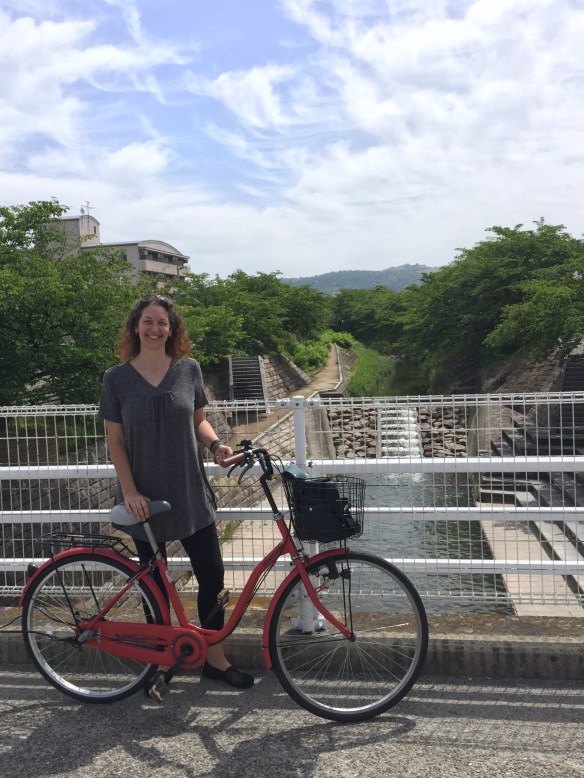
For the rest of the tour, Hiro would stop around ponds and say we should get a photo here. Very sweet.
On the way to Nara Park, we rode through the small campus of the Women’s University, which was pretty quiet on this Friday. Our first stop in the park was Tōdai-ji temple, the site of the largest Buddha, or Diabatsu, in Japan. Hiro asked if I wanted to go in and said he would wait outside for me and that I should take my time.
I paid the ¥600 admission fee and entered the grounds along with many, many other tourists. A long pathway with grassy lawn on either side leads to the Great Buddha Hall, or Daibutsuden, so you get a nice view of it from a distance before you make your way to enter.
The Great Buddha is 49 feet tall and elevated on an elaborately decorated platform, so is thus quite impressive. Nonetheless, my first thought was that the Daibatsu in Kamakura may have “second” status due to being 44 feet but I liked it better. The patina over the bronze, the open-air setting, and its serene repose endeared it to me. Which is not to say I didn’t enjoy seeing the one here. I took the Hall’s circular path that goes around and behind the Great Buddha, past smaller Buddhist statues and display models of the temple’s buildings, former and present. All in all, I spent about 40 minutes on the site.
Upon exiting, I caught sight of my first deer! I found Hiro and we rode around the pond in front of Tōdai-ji, pausing for photos 🙂 We were about to ride uphill when we came upon two deer on the grass just off the pedestrian and bicycling path. We parked our bikes, and Hiro got out the rice crackers that I would have purchased myself if not on the tour but which he included in the Experience.
One of the does was shy and didn’t approach me at all, and the other was quite happy for me to feed her the crackers. I broke the round, flat crackers into pieces and held out my hand for her to eat from. In between each handful, she bowed her head up and down to ask for more. I asked if the deer in this park were trained to do that, and Hiro said it’s natural. In addition to feeding her, I wanted to pet her but she wasn’t so into that. Hiro said there are deer up higher in the park that are less shy.
There were some bathrooms on the other side of the path and I thought I should take advantage. Inside, I found 4 stalls, all of which were squat toilets. In my experience in Japan thus far, bathrooms have been either all Western toilets or a mix of Western and the traditional squat type. This was my first time having no choice but to squat. I was mostly fine with it, my biggest concern being splash potential, like when you’re in the woods.
Before we moved on, I asked Hiro about the mix of toilet types and learned that when he was young 40 years ago, there were only squat toilets in Japan. Over the last few decades, Japan has gradually transitioned to Western toilets, both in new construction, which is cheaper to install than squat drainage from a plumbing perspective, and in conversion, which is expensive. So buildings that haven’t been converted yet are both old and in places without a budget to change them. I asked if older people prefer the squat toilets they grew up with, and he said no because they are much harder to use for older folks!
I also asked if there is any resentment among the people that Japan has been Westernized in this way, and Hiro didn’t think so. This question about international relations led to a discussion about politics in general, and I really appreciated the one-on-one dynamic and Hiro’s openness that allowed me the opportunity to better understand Japanese culture.
We got back on our bikes and rode uphill through Nara Park to Nigatsu-dō Hall, which is part of the Tōdai-ji temple. It has a large balcony overlooking the park and the city of Nara, and Hiro brought me up there to show me the view and share some Nara history and culture. I learned that Nara was the capital of Japan for about 80 years in the 8th century, until the emperor moved to Kyoto; traditionally, where the emperor lives is considered the capital. And I learned that the balcony we were standing on is lined with monks bearing large torches during a two-week fire festival every March.
While we were chatting, I was approached by two schoolgirls who were maybe 10 or 11 years old. They practiced English phrases from their workbook and asked me to write in the country I’m from. It was so precious, I was on the verge of tears as I wrote in each of their books, and then they each handed me an origami crane! My heart was full.
From Nigatsu-dō, we rode our bikes down to Kasuga Taisha, a Shinto shrine dating back as far as when Nara was the capital. Hiro rang a gong and prayed. When I asked about the significance of the gong, he said it’s like saying to the gods, “Hear my prayer.” The shrine grounds feature thousands of stone lanterns, which Hiro said are lit each year on August 15 in honor of the dead.
On the main path through the lanterns, we found many deer 🦌😍. Hiro was right.. they were less shy here. In fact, they were rather aggressive! One doe bit the hem of my T-shirt and a male repeatedly poked me with his antlers, both of them wanting morrrre crackers. I fed them the rest of what I had, and just before we left the park, we encountered a calm and restful doe who allowed me to crouch down and pet her. So cool.
On our way out of the park, we stopped at Ukimi-dō Pavilion, a hexagonal gazebo overlooking Sagi-ike Pond, where I watched turtles and koi in the water.
At this point, we were well past the end of the scheduled tour as it was to go until 11:30 and it was after 12:30. When the morning tour ends, Hiro will often suggest to his group some additional spots and tell them where to return their bikes when they’re done. If he is able, he’ll join them. Today, Hiro had no mid-afternoon group from 12:00 to 14:30 and didn’t mind continuing to show me around Nara. In fact, he had a specific place in mind. He asked if I wanted to go sake tasting! I had tried sake many times, both hot and cold, and never really took to it. I suspected, however, that tasting sake in Japan would be a different experience.
We rode to Harushika Sake Brewery and each paid the ¥500 fee, which includes a souvenir tasting glass. In the main room, 4 or 5 wooden tables with stools surrounded a center area with staff and bins holding the sake bottles. A tasting menu described the 5 sakes we would try. I asked Hiro if it would be in poor form to eat the remainder of my panini, and he discouraged that, which was a bit of a bummer as I could have used some food in my belly prior to sake sampling!
I didn’t think about it for long. I was soon enamored of each of the sakes. I loved, loved, loved all of them. They were all served cold, and all could pretty well be described as mostly dry with a hint of sweetness or fruit. Hiro asked one of the staff for a sampling of pickled vegetables. Tsukemono, or “pickled things”, are often served with rice. The cucumber, squash, and smoked squash brought to us in small plastic labeled containers with toothpicks were more specifically Narazuke as they were pickled in sake lees, the remains of the mash used for brewing.
I really wanted to bring home a bottle of sake, but I just didn’t have the space in my bags. I did get two tasting glasses, though. The ones we used during the tasting were clear, and the brewery allows guests to choose one of four colors for a souvenir. Hiro is a frequent guest and doesn’t take any glasses home with him, so I got to choose a second. Just as I had unexpectedly acquired a souvenir Mission Estate wine glass from Frank, my tour guide in Napier, New Zealand, I was very happy to bring home my small teal and purple Harushika tasting glasses as souvenirs from Japan.
We were both hungry, and Hiro had a bit more time before his next tour at 15:00. He rode us past Sarusawa Pond (last photo stop in front of a body of water!) to lunch at Bikkuri Udon, where I tried somen, a dish of cold noodles. They were served in a bowl of water, and Hiro instructed me how to fill my empty bowl: first choose from the plate of mushrooms, green onions, and nori; then add some of the cold noodles; then pour over the dipping sauce — tsuyu — but not so much that it becomes a soup.
A few doors down, Hiro showed me a sweets shop (I didn’t know it at the time, but researching it now, it’s called Nakatanidou). The corner of the shop had large plate-glass windows through which we could see some wooden barrels and mallets. It was 14:30, and Hiro was sort of stalling for time. He wanted me to see this shop’s famous mochi-making. Eventually, we had to get moving for him to meet his next group, but he showed me this video on YouTube featuring owner Mitsuo Nakatani, master mochi maker, particularly of the high-speed variety. Crazy!
We rode to a bike shop near Kintetsu-Nara train station, a different one than where we’d started but where I could turn in my bike. I hugged Hiro goodbye and thanked him profusely for showing me so much of Nara. He went super overtime with me, and I absolutely loved it. I wondered how much of my customized tour had to do with me being an Airbnb employee, though I had a feeling Hiro is a stellar host to all.
I rode the Kintetsu-Nara line back to Osaka and arrived at almost 16:00, and I was tired tired tired tired tired.
I laid down and began researching transportation to and in Kyoto. I also shared an Instagram story of my encounter at Nigatsu-dō Hall with the schoolgirls. I don’t know how Hiro ended up with my phone, but he had video’d the whole thing and I was so grateful.
It had been almost a week since my last Facebook photo post, which was of Bali. I hadn’t shared any of my Japan experiences yet. Little did I know between the volume of photos and the crappy wifi at my listing that it would take me 4 hours to assemble and upload posts for the first 4 of my 8 days in Japan!
Deciding where to go for dinner was easy. I had a recommendation from Hiro for, of all things, Japanese-Italian. He said he and a friend regularly visit Saizeriya because it’s cheap and tasty. I’d tried a lot of authentic Japanese food, and I was tired and didn’t mind “cheating” by getting Italian because it was *Japanese-Italian* and because it was recommended by a local! Also, there were a few locations in Osaka, including about a 4-minute walk from the listing.
I was running low on cash and was really hoping to skate by on a credit card until tomorrow, but alas, a sign immediately upon entry informed me that Saizeriya, like seemingly everywhere in Japan, is cash-only.
I walked back down from the fourth floor to the street and looked up nearby ATMs, except I searched “bank”, thinking if I found a bank ATM, it might not carry a fee like a convenience store ATM would. There were two “banks” nearby, but they ended up being electronic kiosks of some kind that did not dispense money, or at least did not look like machines I should put my debit card in.
I searched again for ATM and found that the nearest was downstairs in the Kintetsu-Nippombashi subway station. I found “Seven Bank”, with a similar logo to 7-11 stores. Aaaaand it carried a fee. Ah, well.
It was 22:00 by the time I arrived back at Saizeriya. The host thankfully spoke enough English to ask if I wanted smoking or non- (such a throwback!). I was seated in a booth and then left alone for a suspiciously long time. No water, no menu.
Or so I thought. As I waited, my gaze wandered and eventually landed at the end of my table, where there was silverware, a menu, and a buzzer/bell thingy. A-ha!
Hiro had recommended the escargot — not feeling it — and the pasta with squid ink.. sure, OK. Spaghetti “Nero di Seppia” it is. And wine.
I pushed on the ringy-dingy, and a server appeared immediately. I pointed at the menu to place my order and finished with “Omizu, kudasai?” This means, “Water, please?” I was directed to a self-serve station at the back of the restaurant. It is very DIY here.
Seated with my water, my food also arrived very quickly, along with the bill. That would be the last I saw of any staff until I brought my bill to the front desk/hosting station to pay. In a country without tipping culture and in cities with millions of people, this efficiency makes total sense.
The wine came in a mini-carafe, far more than I was expecting. The spaghetti was very, very dark green, almost black. It tasted about as I expected it to, with a mild and not overpowering fishy flavor. I had far more wine than food, and I sat until I’d enjoyed all of it.
Hiro wasn’t kidding about cheap. The pasta was ¥499 and the wine ¥200. Together, the meal cost about $6.40 USD.
Back at home, I wanted to be productive with money stuff or journal writing, but I was slightly tipsy and very tired. After some random Internet time, I slept at 11:45.
 Zoe Means Life