Travel accessories that changed my game

A few travel choices I made that I was very grateful for during my entire trip:

International data plan

In another lifetime when I was a cab driver — 1999, specifically — we were given phones on the Voicestream network that we could use to text dispatch and other drivers. (Texting was not really a thing yet, and I felt very cutting edge. I was proud of my ability to tap out messages with my thumb without looking, e.g. two taps on the 1 key for the letter ‘b’.)

Voicestream was bought by T-Mobile, which remained my carrier until I bought my first iPhone in 2008, when AT&T was the only available network for iPhones. I stayed with AT&T through my second iPhone in 2010, not paying enough attention to my plan and realizing shortly before I switched carriers again that I could have long ago been paying less for more and better services.

By 2014, upon purchasing my third iPhone, I was traveling and I went back to T-Mobile, drawn by their offering of international data, a default of every plan. What a life-saver! Not needing to buy a SIM card or rely on the hope of finding wifi hotspots in order to navigate my way around is an essential component of my travels.

Packing cubes

On Amazon Prime Day (which has its critics) in 2017, I bought some packing cubes made by eBags. I’d heard they can save space in one’s luggage, and oh boy did that turn out to be true. Total game-changer.

What they did for me on this trip was something else entirely, though. Most of my stays were 1 to 2 nights, not really enough time to unpack and get settled. Except with everything compartmentalized, it was very easy to unpack and repack!

I always knew where everything was because I’d categorized: one large cube holding leggings and outerwear, one large cube holding tops and outerwear, one medium cube holding undies and socks, and one medium cube holding my laptop, battery, and chargers.

These four cubes filled my 21″ roller suitcase to the brim (and then I packed shoes on top), and I can’t even imagine trying to manage all my stuff without them.

Portable battery

For Christmas 2015, I received a small portable battery for my iPhone. I didn’t use it much until I traveled to Barcelona in the summer of 2017, and I found that it really helped supplement the power consumed by photos and navigation.

Having become a devoted user of the video journal app 1 Second Everyday since then, I would be taking more videos on this trip than any previous one. The small battery had stopped holding a charge, so I had an opportunity to buy a bigger and better one for my big trip.

I chose this one from Anker and loved it. Compact, not too heavy, holds a charge for days, can power up my iPhone almost twice over. It was a life-saver on my long days of touring about.

Japan

In no particular order, some observations and notes about my experiences in Japan:

Rules / structure / order

There is a proper way to do anything logistically, and even if I didn’t always know what it was, I appreciated that it existed. The people conform to organizational protocols because it makes their lives easier.

I saw this from the moment I stepped off the plane and went to exchange my Japan Rail Pass voucher for the pass itself. There was a specific order to the proceedings — first the form, then the line — as well as a guide at the entry making sure everyone followed it.

The punctuality of Japanese trains is taken so seriously that apologies are issued when a train departs at the wrong time, whether 5 minutes late or 25 seconds early.

At odds with this is the individualistic American mentality. We don’t want to conform, and we don’t want to be told what to do. We want it our way.

That whole “grande, extra shot, half caf, soy latte, no foam” kind of coffee order doesn’t exist in Japan.

So, so many people

I regularly experienced that thing where you and an oncoming fellow pedestrian sidestep in the same direction until you almost run into each other.

If you need to cross through opposing lines of pedestrians, you cannot wait for a break in the flow or you will never pass. You must cut someone off.

There are literally lines to wait in lines.

I prefer my photos to be people-free, and I was often at cross purposes with another photo-taker.

Crime

There isn’t any. I mean.. there is very little. Theft and assault are just not concerns of either the locals or even visitors. As with both New Zealand and Bali, I did not need my usual street-smart vigilance to feel comfortable walking around alone, even at night. It was such a gift.

Escalators

This was interesting.

In Tokyo, escalator riders stand on the left and walk on the right. In Osaka, they stand on the right and walk on the left.

This may have something to do with rivalry between the Kansai (Osaka) and Kanto (Tokyo) regions of Japan, but no one knows for sure, at least according to my Google research, why this is.

Language

My last Airbnb host in New Zealand told me a story of her visit to Japan in which a restaurant refused to serve her and her friends because the staff didn’t speak English. I learned from Cindy, my former co-worker I met up with in Tokyo, that this is not xenophobia but rather pride. If they cannot meet a standard of excellence in their hospitality, the Japanese would prefer not to host you.

In my personal experience, the Japanese do not understand what you say in their language if you mispronounce a word. This is not inflexibility or judgment on their part; they literally do not hear the word you are saying. Fascinating!

I was surprised to find the most English speakers in Kyoto rather than in Tokyo.

Religion

I never quite got a handle on the mix of Shinto and Buddhism I encountered everywhere. These faiths seem to co-exist with their own symbolism and practices but also inform one another as well. I might have that completely wrong. Hiro in Nara was probably my best chance at understanding this, and we didn’t talk about it.

I was also confused by all the praying to Buddha I witnessed. My conception of the Buddha is not as a deity requiring worship. Again, what do I know.

Smoking

Wow. It’s still allowed everywhere.

Toilets

As mentioned in my Nara post, some are still of the squat variety. Heated seats are divine. The option to play musical notes to mask the sounds of taking care of one’s business is delightful. Spray options for clean-up were hard to get used to but also just make so much sense.

Bathrooms

So many have no soap or paper towels! I observed many women carrying around a cloth for drying their hands after rinsing at the sink. I think that’s great. And I’m OK with a hand rinse after peeing. After a poo, I want to wash with soap and my American ass found it odd that this was not an option in many public bathrooms.

Soft serve

The Japanese are a bit obsessed.

Kyoto -> NRT -> PDX

I awoke at 6:30 on the last morning of my 5-week trip. I iPhone’d myself awake and got up just after 7:00 to get dressed and pack all the way up. I took a couple photos of the tiniest listing, and I was out the door at 7:45.

It was realllly raining. I was thankful for the cover of the Nishiki Market a block away. As I walked past, I observed all the vendors setting up shop for the day, feeling wistful already about leaving Japan.

I rode the subway from Shijo to Kyoto Station. I exited the subway to enter the shinkansen boarding area, only to exit again so I could visit the ticket office (sigh). Reserved cars on the 08:58 train were sold out. I could either ride in a non-reserved car or book a seat on the 09:58.

Not knowing what to do about that, I switched gears and asked to refund the balance/deposit on my ICOCA transit pass. Alas, that’s a different office, upstairs. With all my bags, I used the elevator and found the office where I easily turned in my ICOCA card for the full ¥500 deposit, despite having read that they would keep a fee.

Back downstairs, I considered my options. I had not yet ridden a shinkansen train in a non-reserved car, and I didn’t know if there was a possibility the 08:58 would fill up. The 09:58 train would still get me to NRT over two hours before my flight left, but I would vastly prefer an extra hour in the Delta lounge over killing time at Kyoto Station. On the other hand, I didn’t want to risk not getting on *either* the 08:58 or 09:58. I reserved a seat on the 09:58, as well as a seat on the 12:50 Narita Express from Shinagawa in Tokyo.

Then… I researched the penalty for not showing up for a reserved seat. I really wanted to get on the earlier train. As it turns out, there is no monetary penalty, only the karma of having held a seat someone else could be reserving.

I purchased several items for breakfast: an egg sandwich, a croissant, a fruit and vegetable drink, and onigiri. When the 08:58 train arrived, I boarded a non-reserved car and found a seat with ease.

My first order of business, then, was to ask an agent to cancel my 09:58 reservation. When one passed through, I flagged her down and made the request with a combination of Google Translate and showing her my ticket. She asked for my non-reserved seat number, and I had no idea why. Was I in trouble? She said, “One moment, please,” and then left for a long time.

I ate my breakfast, which included the experience of *finally* pulling the plastic away from the onigiri without tearing the nori. Win.

Eventually, a different agent came back with a handheld machine into which he entered my reservation and successfully canceled it. So the first agent needed my seat number for the second to find me and carry out my cancellation request. Whew.

Arriving at Shinagawa Station at 11:33, I exchanged my 12:50 seat reservation on the Narita Express for 11:50. Karma satisfied!

The NEX arrived at NRT at 12:58pm, exactly as scheduled — not a surprise but amusing nonetheless. My Delta One reservation afforded me priority everything, starting with a separate check-in line. I was so early and the airport so not busy, it didn’t make any difference, but it still felt good. Picking up the phone conversation from yesterday, I asked about the seat change and was told they could take care of switching me back at the gate – yay!

Security and customs were a breeze, so I had nearly 3 full hours before departure. I had almost ¥1,000 yen remaining (~$9 USD) and shopped for a maneki-neko (fortune cat) souvenir, finding a perfectly cute and small one for ¥480.

I spent the next hour and a half in the Delta lounge, noshing on curry noodles; rice with wasabi, soy sauce, and shibazuke — bright purple pickled eggplant and cucumber, a specialty of Kyoto; crab egg soup; and some American-style veggies and dip. I had a small glass of white wine and some sake, which to my surprise I greatly enjoyed (it wasn’t just at the tasting.. seems it carried over).

I still had almost ¥500 yen to spend and I wanted to ensure my seat change, so I left the lounge to go to my gate just a bit early. Or so I thought. People were all lined up, and pre-boarding was happening. There was no wait at the counter, though. The agent first told me 5D was already occupied, and when I pushed a bit, saying the check-in attendant left a note in the system, this agent apologized and retrieved my new boarding pass, already printed. Whoo-hoo!

If ever there was a time I need not be anxious about boarding, this was it. I had “premium” priority, so a much smaller line, and my own overhead bin awaiting my stuff. I wandered back into the gift shop to see what else I might want and could carry. If I’d found nothing, it would have been fine to eat the cost of the remaining yen, but I came across a pouch of matcha powder for ¥500. Easy to carry and an appropriate souvenir, given yesterday’s demonstration.

I actually had ¥508 yen on me, but I wanted to keep one coin as a souvenir; I’d done the same in New Zealand and Bali. So I tucked away a ¥50, gave the cashier ¥458, and charged the remaining ¥42 yen to my credit card (all of $0.39 USD).

I made it back to the priority line in time to wait just a couple minutes to board. My timing couldn’t have been better.

My name preceded me with the flight attendants, whether due to the seat change or my vegetarian meal request. They repeated my surname a couple times and said something about a princess. As I often do, I noted that I share a name with Angela Merkel, the chancellor of Germany, and then I realized they were thinking of Meghan Markle, so I guess that’s a thing I’m going to be hearing for the rest of my life now. Out of curiosity, I checked her Wiki and it seems that an ancestor of hers changed the family name from Merckel to Markle.

I got happily settled in seat 5D, the main difference from 6D being that the seat is next to the window, with space between the seat and the aisle, as opposed to being right on the aisle with space between the seat and the window. Big difference.

I ordered a mimosa, because of course I did. We took off on time at 16:20, and I set about taking care of my comfort needs one by one. I reached up and turned off my neighbor’s cold air because he was already sleeping. I went to the loo and removed my contact lens. The video system needed a reboot, which was fine as I didn’t want to manage a movie and dinner. It was a good thing I was hungry, despite my lounge treats, because we were soon served a four-course meal: 1) wine and nuts, 2) an appetizer tray as large as an economy meal, 3) entree (I had rockfish), and 4) mousse for dessert.

After dinner, 2h45min had passed, leaving about 4h45min to lay down before breakfast would be served. The house lights went off just before I shifted my chair to a bed. This moment I’d been anticipating for so long and been so curious about did not disappoint. I can definitively say that laying down on an airplane is *awesome*.

I slept a solid hour and a half, followed by a not so solid hour. Unfortunately, that was all for sleep. At that point, it was still only 21:30 body clock time.

Since we left Japan in late afternoon and would arrive in Portland in the morning, I’d been curious as to whether we would fly through daylight all the way, or have a night…? I was proud of earning an “A” in general astronomy at UC Berkeley, but this part of the class had confused the hell out of me. I decided to risk letting in light by taking a peek out the window, and I was so glad I did. I unveiled a magical night scene, a mostly full moon directly above a blanket of striated clouds. So peaceful.

For the remaining time, I alternately listened to music and used earplugs and an eyemask for rest, if not sleep. Breakfast was another huge meal, which I ate sitting up but with my seat still fully reclined. After eating, I laid back down and edited photos on my phone. I was not ready for my lay-down flight experience to end!

But alas, end it did. Upon landing in PDX, I cried a bit as gratitude and wonder at all the things I’d seen and done over the last 5 weeks overcame me.

Kyoto: Ami Kyoto Teahouse / Philosopher’s Path / Kiyomizu-dera

I awoke at 6:15. The sunrise was at 5:00.. no wonder.

I immediately felt itchy all over from multiple bug bites acquired at Fushimi Inari, and my legs were sore from all the step climbing. Like the end of my time in Bali, I was feeling pretty beat up.

I keep thinking early awakening is time to edit photos or write here, but instead I just open Facebook and Instagram. I might be tired of my trip 😳

After social media distraction, I messaged my host in Osaka to remind her to please respond to my reimbursement request. This led to reviewing some work emails…

I showered and got dressed and walked to breakfast, stopping at a convenience store along the way. I’d really hoped my 5-week trip would only include one period, but instead I got one in the first few days, during which I used up my supplies, and I was due for another as my trip was wrapping up.

For my last leisurely morning in Japan, I’d found a restaurant, Iyemon Salon Kyoto, that serves authentic Japanese breakfast. I ordered the breakfast set, which I unfortunately needed to eat quickly. Though I’d woken up early and didn’t need to be anywhere until 11:30, I didn’t arrive at the restaurant until 10:15. I wondered how I manage to pass so much time doing not much of anything. While I would have liked to take more time to savor the elaborate tray served to me, I thoroughly enjoyed the fish and mushrooms; rice; tsukemono; miso; and tea.

At 10:50, I embarked on 40 minutes of walking, first back to the listing to drop off my convenience store purchase and then across the river to Ami Kyoto, an 80-year-old townhouse where two women, Mari and Kimi, share traditional Japanese culture by giving demonstrations of and educating guests about the tea ceremony, calligraphy, and ikebana (flower arrangement).

I found my way there via “Tea ceremony in Kyoto Townhouse”, my final Airbnb Experience of the trip. The four of us were seated along the back windows of a small room with tatami mats, tea making equipment in the center. Mari was our guide for the next hour.

She introduced us to the four principles in the Way of Tea: peace/harmony/balance (和 wa); respect, including that for nature (敬 kei); purity (清 sei); and serenity/tranquility/rest (寂 jaku). We learned about the etiquette of the traditional tea ceremony for both host and guests. There is a proper way for guests to enter the teahouse. Once inside, they admire both the tea-making setup and the arrangement of scroll, simple flower and vase, and incense that the host has assembled. After this educational piece, we each had an opportunity to practice entering the teahouse and showing our respect for the arrangements.

At this point, Mari requested we put our cameras away in order to be immersed as she performed a demonstration of making the tea. Her ritual movements as she made tea were perfectly precise and choreographed. She passed the freshly prepared tea bowl to the first guest, who raises the tea toward the host in respect, rotates the bowl so as not to drink from the front, sips, wipes the rim of the bowl, and passes it to the next guest and so on. At the conclusion of the demonstration, Mari entertained our questions, which was great as I had many!

Lastly, we made our own matcha. First, a rinsing of the bowl with hot water. Then two small scoops of powder and more water, which we whisked together briskly until foaming. Mari took photos of us sipping from our tea bowls. I enjoyed the whole experience and only wished it were 90 minutes. I would have liked some time to sip on my bowl of matcha.

At 12:30, I stepped outside, feeling ambivalent about pushing forward with one last day of sightseeing. I decided to walk the Philosopher’s Path in addition to visiting Kiyomizu-dera, though they were in opposite directions. I needed a top-up on my ICOCA card.

I checked for a nearby station and found Higashiyama just a couple blocks away. By the time I arrived, I already needed to use the restroom again, though I’d done so just before leaving Ami Kyoto. The station’s restrooms were behind the gates to the trains, whereas I was going to be taking a bus from outside. I used the Google Translate app to ask the station agent politely if I may use the restroom without entry fare, and she allowed it. Whew!

Back out at the fare machines, I used Google Maps to figure out how much fare I would need for the bus and train trips I’d be taking for the remainder of my stay. I added ¥590 JPY to my ICOCA card. Ack! And then I was in danger of falling just short of needed cash for the remainder of my stay! Perhaps I should have withdrawn ¥5,000 instead of ¥4,000 yesterday? I had about ¥2,100 left, or approximately $19 USD. I would need to find a restaurant that takes credit cards for dinner, which had been a challenge.

At 14:00, after a 20-minute bus ride and a short walk through a Kyoto residential neighborhood, I arrived at the Philosopher’s Path, which follows a canal in Northern Higashiyama and is another spot lined by sakura in April, alas. It was still beautiful and quiet and calm in May. There were a few people here and there, including some locals, which was lovely after the crowds in Arashiyama and at Fushimi Inari. Signs pointed the way toward temples off the path, but I opted for a lazy southernly stroll, taking photos of fish in the canal and flowers lining the path. Also? Cats! Many strays live along the path and are fed by locals.

I reached the end of the Path at 15:00 and made my way through the neighborhood back to a main road to catch a bus south. I was looking for the 100, and the stop Google Maps directed me to didn’t have 100 on its sign. I tried to ask some fellow soon-to-be passengers using Google Translate, but four people read my phone and then talked to each other instead of responding to me (?). The 5 bus arrived, I poked my head in and managed to ask the driver where I should be, and he pointed me toward a stop around the corner. Not the first time that Google Maps provided the accurate bus number and route, but the stop was in a different place. Japan so hard.

The bus was crowded, and there were schoolkids riding each turn like it was an amusement park ride or a mosh pit. They all got off with me at my next stop: Kiyomizu-dera, the “Pure Water Temple”. As I’d gathered was customary for such sites, access to the temple required a walk along a street filled with shops and restaurants.

Matsubara-dori was a madhouse. So many people, so much shopping. There had been some sun on the Path, but the afternoon had turned muggy. And I was hungry. I considered bailing on the temple, but I was already there and it’s one of the most prominent Kyoto sights to see, a UNESCO World Heritage site yada yada (and also, only ¥400 to enter).

Once on the grounds, the first stop is the main hall, which, as it turned out, was under construction. Its large wooden stage, from which visitors can view Kyoto and which is arguably why people visit here, was still accessible, but the standing space and the view were limited, so I didn’t recognize until later that I had done the thing that people go there to do.

I then consulted a map of the grounds, and I was very confused as to which way to go and what to see. I took several flights of steps down to the other main attraction of the site: the Otowa Waterfall, from which this temple derives its name. The water flows in three streams that visitors can drink from with long wooden poles, each offering a type of good fortune. There was, of course, a very long line to do this and take photos doing this. I skipped it.

I walked past the waterfall along a path that didn’t seem to be going anywhere in particular. I followed some steps upward and found myself at the Koyasu Pagoda, a visit to which is said to offer a safe and easy childbirth. From the pagoda, I had a nice view of the main hall and the balcony I’d just stood on (here is where I realized I had done the thing I’d seen people doing during my tourist research). Yet, a feeling of “this is it?” persisted.

I retraced my steps along a path above the waterfall, which was lined with hydrangeas on one side and had a better view overlooking Kyoto on the other than the balcony had had. I spent some time admiring the views and also thinking how much nicer they would look if the sun were out. I just may have been sightseeing’d out, Japan’d out, and even Recharge’d out.

My last stop was up some stairs behind the main hall, where one finds the Jishu Shrine, dedicated to the god of love and matchmaking. Two stones are placed 18 meters apart. If you can find your way from one to the other with eyes closed, you will find true love. You can receive guidance, but this means you will need an intermediary in your love life as well. *My* challenge was to take photos of the stones and surrounding shrines with no people in them, which was not possible, though I came close.

On my way out of the grounds, I encountered a pond with a turtle in it and spent a few minutes there. I want to note here that as grumpy-pants as I was during my time at Kiyomizu-dera, in no way did it sour any of my experience in Japan, which I’d found to be an ancient and modern whirlwind of a country.

Japan sightseeing concluded, I took a short bus ride back to my neighborhood, arriving around 17:30 as the Nishiki Market was in the process of closing up. I passed by the street leading to my listing as I needed some food. I made a turn a couple blocks later and encountered Spring Valley Brewery, also a restaurant. Why did this not come up on Google last night?! I went in and asked if they accept credit cards, expecting a ‘no’ and got a ‘yes’!

Though I’d decided after the takoyaki in Osaka that I would not be eating octopus again, the pizza with octopus, ginger, and nori was too intriguing to pass up. With that I also had two half-pints: Jazzberry and Daydream (yuzu citrus + shanso pepper). All of it was tasty, and I did that thing we often do where we continue eating past the point of comfort and consider taking the rest home too late.

Oddly, when I asked for takeaway for the last 2 slices, the server said ‘no’. I was unprepared for this. I asked the English-speaking hostess, and she said, “Well, I guess that means we don’t have any bag.” I asked the server a second time; I was having a hard time understanding and accepting that a restaurant does not offer a means of taking home uneaten food. It was 19:00, and I thought I would get hungry again before bed, but also…. WTF. I ended up assembling a makeshift carry-out tray using three napkins. Success!

I walked a few blocks back to the listing, and it was time to check in for my flight home tomorrow.

I was flying home in the Delta One cabin, or Business Class, complete with a flat-bed seat, and I was very excited. To my dismay, I found that my carefully researched and selected seat had been changed since yesterday when I logged in and made my meal preferences. I called Delta, and they said my original seat was blocked. There was no particular explanation, only speculation: possibly an aircraft change or a special needs situation, like a disabled passenger or one with a baby (neither of which explains the change, since all of the seats in Business Class are of the same type). I asked if it was acceptable to move my seat because I paid with points? The response was an emphatic ‘no’, that I am still a paying customer. I was glad I hadn’t actually paid $2,000+ to then have my seat changed! I resolved to pick this up with Delta in person at the airport tomorrow.

I was feeling not so good from the pizza and beer as I got ready for bed. I showered and washed my hair one more time in the tiniest bathroom, and I packed up. I did get hungry but, ironically, I couldn’t eat the leftovers I had been so stubborn about bringing home.

I slept at 23:00.

Kyoto: Fushimi Inari

I awoke at 7:00. I briefly considered getting “up and at ’em” and imagined arriving at Fushimi Inari by 8:30. Yesterday was a big day, though, and I was feeling a bit out of gas. Not like I needed a rest day, per se, but I needed… a slow day.

I stayed in bed, looking at Facebook and Instagram. At 8:15, I got up and did a full set of back stretches. Today would be another day with a lot of walking.

I took a bit of laptop time. Though I still had two full days in Kyoto, it was time to think about my departure home. I reviewed my transportation plan to the Tokyo airport and my meal options on the flight.

I again looked for breakfast options nearby, though I was aware by now that Japan doesn’t much do breakfast out.

At 10:00, I walked to a local cafe called Hoshino, with a breakfast menu on a sandwich board out front. Amusingly, the item that most appealed to me was called “eggslut”. I went in and found the interior warm, with wooden booths for 1 or 2 segmented by glass partitions.

After I’d ordered a coffee and the eggslut, I decided to look up what exactly this mistranslation was intended to indicate. It looked like an egg in a dish with a side of toast.

It turned out to be not a mistranslation at all, but a dish that originated in L.A. and consisted of an egg over pureed potatoes. As served to me this morning, the potatoes were almost certainly covered in a meat gravy. Oops. Such mishaps occur a handful of times per year. Though I’ve been a pescatarian for 26 years, I’m not so strict about not eating beef, pork, or poultry that I spit it out or refuse to eat anymore. The gravy was quite tasty. I shrugged and kept eating.

The coffee and eggslut together were less than $6 USD. I haven’t found Japan to particularly expensive but certainly cash-consuming! I would need to make a fourth and final ATM stop today.

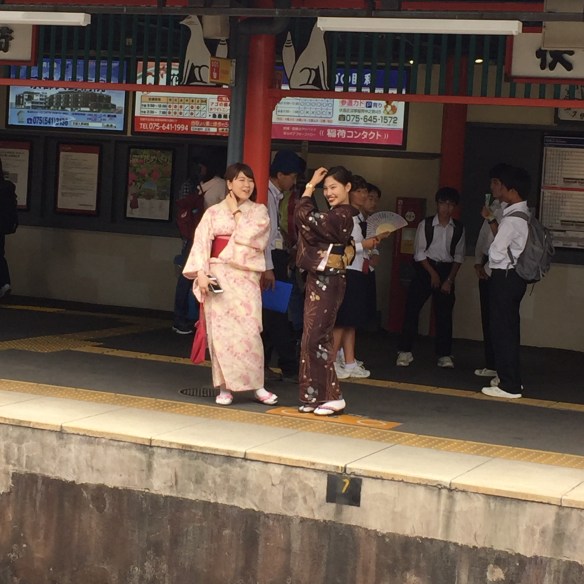
From there, it was a couple blocks to the Gion-Shijo train station and an 8-minute train ride to Fushimi-Inari Station. Upon my arrival, I spotted two women on the other platform, wearing kimono and stylin’ and profilin’ while they were at it. I snapped a photo of them that I adore:

IMG_0515

I would see many kimonos over the course of the afternoon. I got the sense that the appeal for locals is both honoring tradition *and* playing dress-up, i.e. a mix of reverence and fun.

It was a 7-minute walk from the station to the entrance of Fushimi Inari, with many food and souvenir shops along the way. I arrived at 12:00 and of course found the site massively crowded. Seems to be par for the course in Kyoto.

Fushimi Inari is a Shinto shrine renowned for its Senbon Torii, ~10,000 vermilion gates that straddle a hiking path up a mountain through a forest. There is no entrance fee, and it’s open every day of the year, 24 hours a day.

I spent a good half hour making my way from the street through the plaza, past the romon gate structure and the temizuya, to the beginning of the mountain path. I took photos of and observed men and women in kimonos, worshipers at the shrine buildings, and fox sculptures flanking the main entrance. Foxes are thought to be the messengers of Inari, the Shinto god of rice and prosperity (one’s fortune having come from good crops once upon a time).

The hiking trail begins with two parallel rows of dense torii gates; the gates thin out the higher up the mountain you go. I wasn’t sure if I was going to summit; knowing that many people turn around at the Yotsutsuji intersection, more or less the point halfway up, made continuing to the summit appealing.

It doesn’t matter which of the parallel paths you take as they both lead to the halfway point. Setting foot on either proved a challenge due to the bottleneck of people taking photos, myself included:

IMG_0618

Once I got going, I stopped only if I had an extended shot of the gates in front of me with no people in sight. I took as many of those photos as I could, and otherwise, I hoofed it upward.

After about a half hour, I reached the halfway intersection and paused to enjoy the views over Kyoto, as well as sit down for a moment.. it was a muggy day and I was sweaty. The eggslut was not enough breakfast, and I was feeling hungry. I considered getting a soft serve here but decided a sugar bomb wasn’t exactly going to satiate me. Onward!

From the halfway point, the remainder of the trail to the summit is a circuit and you can go either direction. I went clockwise.

As I climbed, there were more people on the path to the summit than I’d hoped, but the crowds certainly thinned out, along with the gates.

IMG_0749

I noticed I was incurring bug bites, which I hadn’t anticipated. In a mountain forest.. go figure.

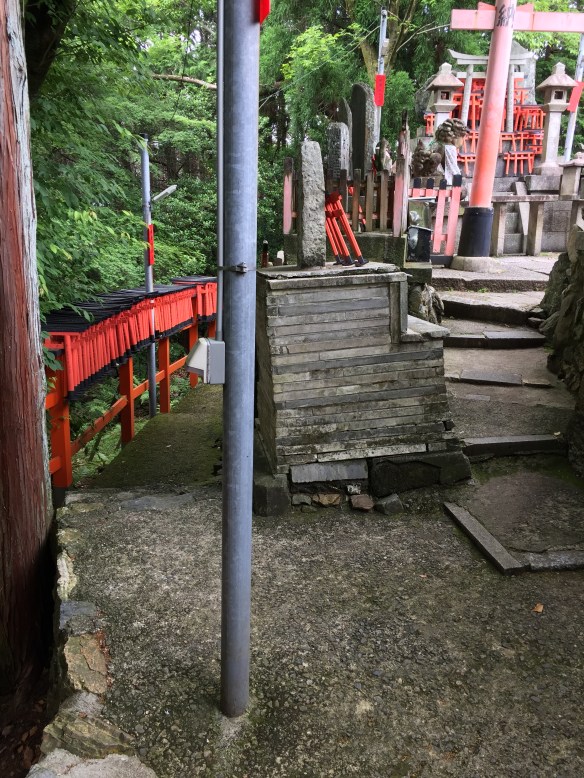
I passed by and through multiple “stations” with drinks, snacks, shrines, and miniature torii gates.

All of the torii gates in the park, from the large ones along the trail to ones you can hold in your hand, are paid for and donated by a business, or sometimes individual, with the cost depending on the size of the gate. The date and donor’s name are written on the back in black paint and are thus visible on the walk back down the trails.

At 14:00, I summited! I walked up the steps to an altar of sorts and discovered paths leading around and behind it. I explored and found hundreds of numbered mini-shrines.

It suddenly occurred to me that there might be a geocache hidden among these shrines. I checked the app, and sure enough, mini-shrine 124 holds a small container in its rocks. I searched and hit a dead-end. While the shrines were mostly in numerical order, they also skipped around when the paths turned corners. I kept moving back and forth between 118 and 132 and just not seeing where I was supposed to go to find 124.

And then I did:

IMG_0789

Sneaky downhill/behind path! Lo and behold, mini-shrine 124 and its hidden treasure:

I was so glad that I’d thought to look in the app and that I had pocket wi-fi. Finding this cache was one of my favorite moments of the whole trip ☺️

After 45 minutes at the summit, I spent another 45 on the descent. By the time I reached the plaza at 15:30, I was very hungry.

I visited the ATM at Bank of Kyoto. I had withdrawn ¥10,000 at each of my previous 3 ATM stops. This time, I took out only ¥4,000, or about $37 USD, for the remainder of today, tomorrow, and my travel day.

On Google Maps, I’d found a nearby udon joint named Omiya but instead inadvertently walked into the place next door, called 伏見庵, or Fushimi-an. It was small and quiet and also served udon. I ordered Inaka: noodles with grated radish, seaweed, vegetables, bonito flakes, and an egg. So good!

While riding the train back to Gion-Shijo, I looked up Kiyomizu-dera, which will be one of my final stops tomorrow.

I walked back to my listing and rested, which meant going through photos and deleting bad ones and duplicates.

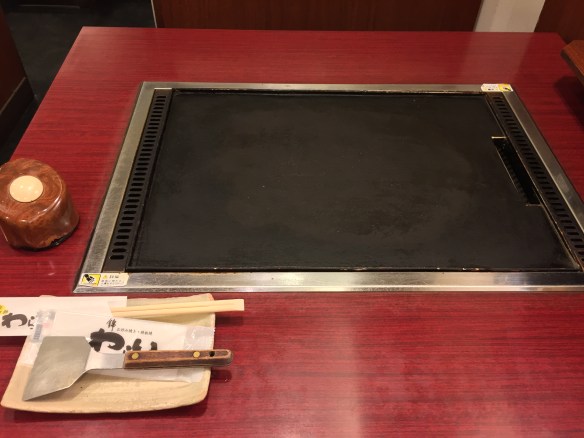
For dinner, I decided I wanted yakisoba noodles (I really can’t get enough of noodles). I looked up a nearby okonomiyaki joint called Nishiki Warai. All the tables have grills. Apparently, some places like this bring you the ingredients and leave you to cook your own dinner. Here, the finished dish is served onto the griddle to garnish as you will and eat away.

I walked about 10 minutes from my listing and was seated right away. I asked for and received a menu in “Eigo”. I ordered veggie yakisoba, and the server turned on my grill.

IMG_0940

I didn’t wait long before the yakisoba was served onto the grill. As with the okonomiyaki in Osaka, I used the steel spatula to cut and serve the food from the grill onto my plate. It was tasty, though a bit greasy and not plentiful enough. I would still be hungry when I returned to the listing.

On the way back to the listing, I looked up more geocaches. There was one I wanted to find as it sounded like it was probably in a pub, maybe an English one as the name was Man in the Moon. As it turns out, it’s Irish and I found the cache! There is a wall hanging plaque of 9 steins in a 3 x 3 formation, and the cache is hidden in the center stein.

I was in the mood for a beer, but the place was small and mostly taken up by the loud voices and cigarette smoke of a party of 3 at a table in the front. I looked up somewhere else I might get a beer and struck out. I haven’t been drinking much beer at all over the last couple years, and I was amused that my interest was reignited in Japan, of all places.

Back at the listing, I continued with photo deletion, logged money transactions, and made five posts on Instagram (from way back in Tokyo).

At midnight, I put another long day of adventure to rest.

Kyoto: Arashiyama / Kinkaku-ji

I awoke at 6:30 on Sunday with bright sun and some neighbor noise. I rolled over till 7:15, when I decided to get up, though I’d allowed myself till 8:00.

With a start, I realized I did not have the luxury to postpone Arashiyama and do a local temple walk instead. I’d booked a tea ceremony on Tuesday, which meant I had today and tomorrow as full days earmarked for Arashiyama and Fushimi Inari, which are in opposite directions.

I got dressed and ready quickly, leaving at 7:35. I stopped at a Familymart on Shijo-dori for “breakfast”: onigiri, soy açaí mini pop tart crackers, a green tea scone, and a banana smoothie. I also used the bathroom, not knowing when the next would be available. (Cindy in Tokyo had shared with me that bathrooms can be reliably found in convenience stores.)

Arashiyama is a sightseeing district on the west end of Kyoto, and there are a number of ways to get there on public transit. It would have been slightly faster to take two subway lines, but the simpler option for me was to take the #11 bus from Shijo-dori: a 50-minute journey but no transfers and with views of the city along the way (though honestly, I spent the ride managing the food in my lap).

While waiting at the bus stop, I looked up once again how to use my ICOCA card to make sure I had it right. Yep, you get on the bus through the side door toward the back of the bus without paying fare. When you disembark, you exit through the front and either pay the driver in cash or tap your ICOCA card on a machine, which automatically deducts the proper fare. I love it!

My first stop in Arashiyama was the famed bamboo grove. The bus lets out on a main road, Prefecture Route 29, right at the “entrance” to the grove. There is no entry fee; it’s simply part of the neighborhood. There is one subtle sign with an arrow and three stone markers; otherwise, you just have to know it’s there.

As I got oriented and was ready to begin on the path, I noticed that coming slowly north on 29 was a procession of some kind, with men dressed all in white, chanting. The ones in front carried paper lanterns on sticks. Behind them, four men in a row held high clanging cymbals that they sounded in unison. I later looked it up and found that this matsuri is known as Saga Festival.

It was 9:00 and there were already many people about. I walked the path that leads past the Tenryu-ji Temple, a recommended sight but not one I was going to see, and into the bamboo forest. Once inside the forest, the dense bamboo stalks rise up on either side of the walking path to heights of 20 meters, or about 65 feet. They are truly majestic, and walking beneath them would have been quite serene if not for all the others enjoying them with me. If I wanted that bad enough, I could have arrived at 6:00, but that just isn’t feasible for me.

The walk through the forest itself is only about 5 minutes long. Near the end of the path through the bamboo is the entrance to the grounds of Ōkōchi Sansō, the former home of and gardens designed by Denjirō Ōkōchi, a Japanese film star of period dramas from the 1920s to 1950s. The entrance fee is ¥1,000 JPY, or about $9 USD. Though that’s not very much, and it includes matcha tea and a sweet at the end of the tour, it’s enough to deter many tourists from visiting, probably in comparison to the free bamboo forest. That’s too bad for them and great for me! I found the grounds not only gorgeous but also peaceful as there were far fewer visitors there. I spent about an hour and 45 minutes walking the path through the grounds, guided by small signs with arrows.

The circuit begins at what looks like it would have been Mr. Ōkōchi’s main house; it was only viewable from outside. The gravel path continues through garden greenery to the Jibutsu-dō shrine, where the history of the villa began. It was the first structure on the grounds that Mr. Ōkōchi built in 1931. He would visit the shrine while working at the movie studios, and he expanded his home and gardens from there. They were opened to the public when he passed in 1962. This area of the garden in particular seemed that it would be particularly stunning in autumn.

Next up were some small rooms that looked like teahouses, but they appeared to have closets so perhaps were guest rooms. (There were no signs or guides.) From there, the path climbed upward and opened on to a view of the valley over the Hozu River, with the Daihi Temple across the way. The upper path continued to views overlooking Kyoto.

I nearly missed my favorite feature of the grounds as it was slightly hidden. When I descended from the upper views to the bottom of the path, a fellow tourist I’d shared much of the sightseeing with asked if I’d seen the meditation room, which I had not!

I went back up a ways and found the steps leading off to the right and around a corner. A sign informed me in both Japanese and translated English that “under 15 years old can not enter” and separately “the child cannot participate”, which I found quite amusing. As instructed in the entryway, I took off my shoes and entered a large space laid with tatami mats, which my feet continued to find delicious.

Both of the large rooms opened onto a combed sand walkway that looked like the traditional Japanese version of a suburban back yard. The first room was bright and empty, leading through a set of open double doors to a second room with some cushions and four short tables upon which sat calligraphy instruments. Each table had practice sheets to transcribe, one of them being “Mother Nature’s Son” by John Lennon and Paul McCartney. At the back of this room were closed double doors through which I peered and found an elaborate altar. I sat on one of the cushions facing the back yard for a moment, taking in the peace and silence.

I went back out and down and reached the bottom of the stairs again. To the right was a square outdoor room paying tribute to Mr. Ōkōchi and his film career, with illustrations, photos, and a video. Back out and to the left of the stairs was the large teahouse, where the tour concluded with a cup of matcha tea and wagashi, a chewy Japanese confection that is less sweet than the Western variety. I sat and people-watched, mostly the servers in traditional kimonos who kept the turnover of tables going.

At 11:30, I exited the villa. I’d had such a full morning already! I walked past the end of the bamboo grove and kept going through Arashiyama Park. I walked south along the eastern border of the park, which ended at the Katsura River. There was a small café and as I stood considering whether to grab a bite, I watched the boats carrying tourists on a river float.

I decided to cross the Togetsu-kyō Bridge in search of a proper meal, at which time I would decide whether I wanted to go to the monkey park over there. I took photos of the small dam at the north end of the bridge. Once across, I sat and admired the physique of a rickshaw “driver”.

I searched Google for a lunch spot and walked through a small neighborhood to Cafe Ranzan, where I was once again asked smoking or non-. I sat at a cute, clean, and comfortable table in the window, with a view of those coming and going from Arashiyama Station. I ordered an egg sandwich and didn’t even care that it was not remotely Japanese (it did come with a small side salad with sesame dressing).

Having already visited a monkey park on this trip, in Bali, I wasn’t convinced I wanted to do it again here, but I decided to for two reasons: my friend Tammy had recommended it, and the monkeys are Japanese macaques, also known as snow monkeys. While the park here does not have snow or hot springs for the monkeys to bathe in (that’s at the Jigokudani Monkey Park in Yamanouchi), I wanted to take advantage of the opportunity to see Japanese macaques in Japan.

After lunch, I walked along a small canal to Iwatayama Monkey Park and paid the ¥650 entrance fee. The monkeys live at the top of a small mountain, about a 30-minute hike upward. The walk was pretty, being on a forest path with waterfalls along the way. It was also a very hot day, and I most certainly took advantage of the A/C room for resting.

Very shortly after the A/C room, it became clear that the top of the mountain was near as monkeys began crossing the path and were visible in trees. The path opened up onto a plaza, with an expansive view of Kyoto in front. In the back was a building housing a caged room. It’s not for the monkeys; they stay wild and free.

Caged humans can feed the free monkeys after purchasing peanuts or bites of banana or apples. The monkeys, being wild, are aggressive about food; absolutely no food is allowed in the plaza outside of the caged room. Neither are the visitors supposed to touch the monkeys or look them in the eye; this can make them agitated and put them in attack mode. (While this may sound scary, the place is completely safe when tourists follow these simple rules.)

I enjoyed both the view and the monkeys meandering the plaza for a bit, especially ‘awww’ing at a baby monkey 🐒

I went inside and bought some banana to feed monkeys with. You stand in front of the wire window and either place the food on the sill within reach or hold the food out for a monkey to reach through and take from you. Of course, it’s far more fun to do the latter.

Or if you’re an asshole, you can tease a monkey by withdrawing the food you’re holding out once it reaches inside, and then laugh about it, while your wife and child look on. I considered and ultimately opted out of saying something to said asshole.

I was about to leave when the park’s 14:30 monkey feeding began. We tourists gathered ’round the center of the plaza while the staff tossed out feed and the monkeys came running. I was surprised that it wasn’t a stampede of monkeys coming to feed, just a few more than are normally in the plaza. Perhaps many had gotten their fill from we tourists?

The walk down the mountain was a bit easier than the way up, of course. All told, I spent about 25 minutes going up, 45 minutes at the top, and about 15 minutes going down. At the bottom of the mountain near the window to pay for entry was a graveled forest clearing with two displays of ema, wooden wishing plaques, and a view of the river through a torii gate.

In between the ema and the torii gate were a number of large, thick slices of tree, with a powerful and intoxicating aroma. I used my Google Translate app to ask one of the staff if they had been scented artificially or I was taking in their natural scent. I must not have used translatable phrases because he was confused at first (or perhaps he understandably found the question strange), but he realized what I was asking anyway and replied that it was natural. I don’t know why those chunks of tree were there, or what kind of tree they were from, but I was glad I came upon them. So fresh and so clean.

It was 15:00 as I walked back out to the main road and had a seat to plan the transportation journey to my next destination, checking the options via Google Maps. I overheard some (German?) tourists sitting right next to me heading for the same place and also looking up how to get there, and I compared notes with them.

Again deciding on a bus rather than a train/bus combo route, I headed north on 29 to go back over the bridge to the bus stop, and what should I come upon but the same procession I’d encountered at 9:00 at the entrance to the bamboo forest! They were now marching south rather than north (i.e. toward me), with some of the participants carrying a palanquin, or mikoshi, and they had drawn a large crowd of spectators.

I made my way against the tide of onlookers, over the bridge and to this morning’s bus stop. I’d been in a rush to catch the bus, but the scheduled time came and went with no bus in sight. Little did I know the area buses had been rerouted due to the matsuri. I had neglected to notice a sign on the stop, but thankfully, a young couple approached me to say in limited English that the bus would not be coming and I could take the train instead. Thank you, thank you, kind Kyoto strangers/friends!

It was about a 10-minute walk to the train station, and I stopped along the way at a convenience store for a cold beverage.

The San-In line is a JR train, but alas, I had not carried my Japan Rail Pass with me as I did not anticipate needing it within Kyoto city borders and I would just risk losing it for no reason. No biggie.. the fare was only ¥190 and I could use my ICOCA card.

I rode 3 train stops to Emmachi Station and walked the two blocks to where I would transfer to either the 204 or 205 bus. Uh-oh… Google Maps said the bus picks up right in the center of a large octagonal intersection, but in reality, the stops were located at 4 of the 8 corners and I couldn’t tell where I needed to be.

I kind of ran around all the corners looking at bus signs and finally asked someone, who pointed me to the stop I needed to be at (I was almost there!), and I just barely boarded the back of a bus that had arrived there in time for the driver to close the doors. The bus was super crowded, and the doors didn’t close, and the driver was yelling something over the loudspeaker, and I suspected he wanted me to either get off or push further in over the yellow lines on the floor so he could close the doors and take off, but I wasn’t sure so I made some hand gestures that didn’t communicate anything to anyone, and then I decided to push inward because I did not want to wait for the next bus and do this all over again. Whew.

I rode the bus for about 15 minutes through the north of Kyoto and paid the ¥230 fare as I exited the front of the bus at my destination at 16:00.

I walked another two blocks and arrived at Kinkaku-ji, also known as the Golden Pavilion. It is a three-story Zen Buddhist temple whose top two floors are coated in pure gold leaf, and it stands, shimmering, at the back of a large pond.

I paid the ¥400 admission and entered the grounds, the first stop being the southern border of the pond, along which hundreds of tourists stood viewing and photographing the golden temple, bathed in the golden light of the setting sun.

My time at Ōkōchi Sansō had been gloriously sunny; the walk across the river, lunch, and the monkey park were mostly overcast and muggy; and here, I was ecstatic that the sky had cleared up again, allowing me a shiny rather than dull view.

Besides wanting to see the Golden Pavilion because it is very beautiful, I was particularly motivated because, without knowing what or where it was, I had an image of it as my desktop wallpaper years ago. When I learned it was in Kyoto and I could see it for myself, I was very excited to do so. Standing in front of it was one of the most heightened (among many) “I can’t believe I’m in Japan” moments for me.

I took my place among the throng, or places, rather. I tried a few different spots to get clean (no people) photos of the pavilion and asked a couple different folks to take my photo in front of the pavilion. It took some patience, but I ended up with some good shots.

I began the walk around the grounds, which first goes behind the pavilion for an up-close look. Nearby is a close view of the koi in the pond. From there, the path takes tourists away from the pavilion and, while pretty, the grounds thus become a lot less interesting.

As I exited around 17:00, the park had just closed (good thing I’d pushed my way onto that bus!). I walked back to the bus stop and got on the 205 in the same direction as before; it turned east and then south toward “home”. It was again standing room only, which was unfortunate as I’d had a very long day of walking and my back was telling me that I really needed to sit down, and it was a 40-minute bus ride.

I was using Google Maps to navigate, and the route showed the stop I wanted in kanji but not in Romanized letters. Thankfully, a screen on the bus shows the name of the next stop in kanji as well, so between following along with my location on the map and comparing the stop I wanted to what the screen was saying, I was able to figure out when to disembark.

I walked about 7 minutes from the bus stop through Shinkyogoku to my neighborhood. Just around the corner from the listing was Beer Pub Ichi-Ya. I dropped in briefly to ask two things: do they take credit cards and do they have wifi…? Yes to both! I went up to the listing and grabbed my laptop.

Back at the pub, I bellied up to the bar. After perusing the menu, I ordered their IPA called Destroy Angel (how could I not?) and some edamame with butter and Japanese 7 Spice powder. I opened my laptop but mostly observed my surroundings.. the goings-on behind the bar, the woman next to me who’d ordered a flight of beers and with whom I exchanged friendly smiles.

I went back up to my room for more cash and came back down, still with laptop, and this time landed at Cafe 363 on the first floor of the building my hostel room was in. I had a salmon and vegetable galette (like an open-faced crêpe) and again didn’t do anything on my laptop as there wasn’t much time between ordering and being served.

In my room to stay, I went through photos on my phone and deleted duplicates and images not worth saving.

At 22:30, I put my very long touring day to rest.

Osaka -> Kyoto

I first woke up at 7:00. I had the option, of course, to fully wake up and do some writing, but I rolled over until 7:50, just as my alarm was about to go off.

Apparently, I used the last of the wifi to log money transactions because when I tried to read Facebook notifications on the dozens of photos I posted last night, not only was I not able to load them but I spent 20 minutes just trying to log off my account.

I showered, got dressed, and packed up. While eating the remainder of the Starbucks panini from Nara yesterday, I discovered it had chicken in it. I don’t eat chicken. I’m not sure how I didn’t notice at all yesterday, or why Starbucks chose to call a chicken panini Spinach and Cheese. I washed the very few dishes I had used — a bowl for the eggs, a water glass — and took photos of the garbage in case there was any doubt that I had complied with this listing host’s very exact, and exacting, instructions.

The host sends messages through the Airbnb platform before check-in and checkout, reminding guests to follow the rules in the house manual. The checkout message includes a warning that a fee will be assessed if the guest has not departed by 10:00 on checkout day. I was glad to leave the apartment at 9:50 and messaged the host that I was out early. The space was very large by Japan standards, and the location was superb. But the house manual that seemed at first to be a well-organized and helpful guide came to feel very micro-manage-y, and the poor wifi had a severely negative impact on my stay overall.

I was already cranky about the wifi in the listing, as well as being so difficult to find anywhere in Japan, when I walked 10 minutes to the subway station and wasn’t seeing the line I needed on the signs. Turned out I was at the wrong Namba station. There is Osaka-Namba, Namba, and Ninkai-Namba. I needed the middle and I was at the latter. Japan so frustrating!

I walked a bit to Namba Station. I was down to the last ¥100 on my ICOCA card, and I topped it up with another ¥2,000, both to ride the Midosuji line from Namba to Shin-Osaka and to have funds to get around Kyoto. At Shin-Osaka, I reserved a seat on the next shinkansen to Kyoto. I had about 15 minutes to grab some food and opted for another smoothie drink and a cinnamon roll (though sweets aren’t really my jam).

It’s about an hour by car from Osaka to Kyoto, but the shinkansen is only 15 minutes! It was 11:30 when I arrived, and I spent a half hour standing in Kyoto Station, trying to connect to the station wifi to decide my next move, as listing check-in wasn’t until 16:00. With a weak connection, I looked up where to go for a better wifi connection, which apparently was Starbucks. Until Nara yesterday, I had ignored all the Starbucks I’d seen on my trip, but it seems that for all the trouble I’ve had finding wifi in Japan’s public spaces, Starbucks was the answer all along.

I exited the shinkansen area of Kyoto Station, only to realize I needed to go back in to connect to the subway. Most transit signs are in English, but the directional arrows are different than I’m used to and not always clear, so I was constantly walking the wrong way, and here I literally walked in circles. With no elevator or escalator option, I carried my suitcase and backpack down 3 separate flights of stairs and arrived on the platform just in time to miss a train. Such a frustrating morning.

I rode the Karasuma line from Kyoto Station two stops to Shijo Station and walked, in the direction of where I’d be headed to the listing, 5 minutes to Starbucks. I ordered a grande chai latte and got situated with my bags in a corner of the shop. The wifi required registration once per hour, but it was free and it worked. I spent 2 to 3 hours catching up on journaling, with notes in blog drafts as opposed to full posts; successfully reading and responding to those Facebook notifications; and reminder-researching Kyoto to make a plan for this evening and the next 3 days. While reviewing an email I received from a friend, I realized that I could see one of her dinner recommendations across the street from where I was sitting. Cool!

When it was nearly time, I walked 7 minutes to the listing for check-in. The room was very tiny, but I knew that when I booked it. I would mostly be out exploring Kyoto, and it was in a great location. I unpacked and charged my laptop and went out to explore at 17:00.

One of the most famous destinations in Kyoto was just a block away. Nishiki Market, also known as “Kyoto’s Kitchen”, is 5 covered and narrow blocks of over 100 culinary stalls, offering samples and selling fresh fish, produce, tsukemono (pickled things), wagashi (sweets), and knives/cookware. It’s 400 years old!

I wandered and observed until the market seemed to grow much larger and was no longer selling food. Why is there a shoe store here? Ah…. there are several covered markets, and I had wandered into Teramachi and Shinkyogoku, both of them high-ceilinged and wide, with the feel of an American shopping mall (save for the occasional Shinto shrine!).

I made my way back to Nishiki, where the stalls were beginning to close up. Pre-dinner was a shrimp and green onion fish cake on a stick for ¥ 450. I walked to the west end of the market and kept going until I reached Ippudo, the ramen restaurant across from Starbucks recommended by my friend Tammy, who ate here last year.

I was seated at a counter running parallel to the kitchen. I ordered a vegetable ramen with egg and a large Suntory beer, watching the chefs as I waited for my food, which took no time at all.

At 19:00, it was dusk and I walked about 15 minutes back through the markets and on to the Shijoo Bridge over the Kamo River, a lovely and lively scene as sunlight faded in the sky, the street lights came on, and the moon rose.

On the east side of the river is the famed Gion, known as the geisha district. Evening is when tourists may catch a glance of geisha between their teahouse engagements, but alas, it was not to be for me. Still, I enjoyed strolling the quiet streets with their wooden townhouses and izakayas.

At the east end of Gion is the Yasaka Shrine, which I’d read was lit up at night. It was crowded when I reached it, but I was patient and managed to grab a photo with no people in it. I later learned that I had not actually visited the shrine, which is lit by lanterns, which sounds lovely. I would have needed to walk into the grounds; what I had seen was the lamp-lit gate to the shrine. Japan is hard.

On my way back to the west side of the river along Shijo-dori, I passed by a sweets shop called Nana’s Green Tea. While I don’t generally go for sweets, the pretty menu of green tea lattes and parfaits caught my eye, as did the display window. I talked myself out of getting anything, but I was given a second chance when I found another location near my listing.

There were about a dozen gelato flavors to choose from: matcha, of course, and also things like red bean and black sesame. I wanted something not too sweet and tried the black sesame. I liked it but opted for the classic matcha, after which I wished I’d gotten the black sesame, which was a bit sweeter! 😜 I found seating upstairs (with wifi!) and enjoyed my gelato with a view over Shinkyogoku.

I arrived back “home” at 20:45 and embarked upon laptop time: I logged money, messaged Anthem Blue Cross regarding an incorrectly processed claim (grr), and deleted work emails. I showered in the tiniest bathroom that ever was and washed my hair.

I had planned on an early morning to arrive at some popular tourist stops as early as possible, but it was pretty late now and I thought perhaps I would do Arashiyama on a later day. With that, I slept at 1:00.

Osaka: Nara

I got up at 7:00, with an alarm this time, and got dressed and ready to go, eating the two last black eggs before heading out.

As I stepped outside and began walking, I realized I was out with the commuters. I first stopped into Lawson for a small bottled smoothie to drink on the train and then descended the stairs to Kintetsu-Nippombashi Station. Not Nippombashi Station, mind you, 100 meters away. I had investigated and determined on my way home from Dotonbori last night that they are distinct stations.

I was early for the 7:51 train and perused the wall sign that displayed stations and routes and classes of train. Something called Limited Express required a special ticket. When a train approached earlier than the one I was waiting for, it was going my way and didn’t appear to be Limited Express, so I got on. This felt very daring of me, like I was testing the boundaries for a foreigner navigating transportation in Japan.

I rode the Kintetsu-Nara line the 40-minute journey to Nara. I sat next to a young girl reading through a schoolbook teaching her English. I considered asking if she wanted to practice with me, but that felt too forward and I decided against it.

I had first heard of Nara from a co-worker who lived in Japan for a year when she was in college, and I also encountered it in my pre-trip research. It’s a popular day trip from both Osaka and Kyoto, its largest draw probably being the tame deer roaming Nara Park that you can pet and feed crackers to. I mean, that was why *I* wanted to go! During my down time in Osaka yesterday, I’d come upon an Airbnb Experience consisting of a guided bicycling tour and decided to book it. Other than feeding the deer, I wasn’t sure what else I was going to do, and I really liked the idea of both biking and seeing parts of the town I probably wouldn’t see otherwise.

The meeting point at 9:00 was the Starbucks at JR Nara Station, about a 10-minute walk from Kintetsu-Nara Station where I’d disembarked. I had loaded the walking directions on Google Maps, which was good because for some reason I wasn’t getting any cellular signal in Nara. I was fairly certain a phone reboot would fix that, but I couldn’t risk it. If I rebooted or allowed the phone to auto-lock or even switched apps, anything that reloaded the Maps page, I might not find the meeting point and could miss the tour. Heavy reliance on smartphone is heavy.

I arrived at the Starbucks about 10 minutes early and texted Hiro, the guide, while I waited in line for a panini. I knew the tour involved a snack but I didn’t know when or how much food that would be, so I just kept eating more breakfast items this morning. Hiro found me in line and we sat down so I could eat, though he let me know the snack would be the first stop of the tour.

Hiro was born in Nara, grew up in Osaka, spent some time in Tokyo, and came back to live a quieter life in Nara a few years ago. He learned to speak English very well while working in the hospitality industry, which also naturally led to his hosting this Experience. He joined an Airbnb meet-up with a friend and was interested immediately. He has been running his bicycling tour only since January and has 175 five-star reviews, despite never asking his guests to write one.

As it turned out, I was the only guest on the tour today! Many Experience hosts have requested Airbnb to establish a minimum guest count, and I asked him if he also wants this. He said he doesn’t mind spending the time with just 1 or 2 guests as it allows for more attention per guest. I was thrilled for the same reason! I put half my panini away, and as we left Starbucks to walk to the bicycle shop, Hiro asked me what I do and I told him I work for Airbnb. He jokingly said he was nervous and better give me a good tour, and I assured him I wanted the same Experience everyone gets.

We picked up my bicycle and rode north to and then along the Saho River, stopping at a covered picnic table. Hiro got out a bottle of roasted green tea (tasted just as it sounds) and a small box of Nara sushi. Since Nara is not near the sea, in the days before refrigeration, sushi was fermented with vinegar and wrapped in persimmon leaves to keep it preserved.

Nara sushi

On our way out from the picnic table, we rode on a bridge over the river and I told Hiro I absolutely love water features. He offered to stop and take my photo:
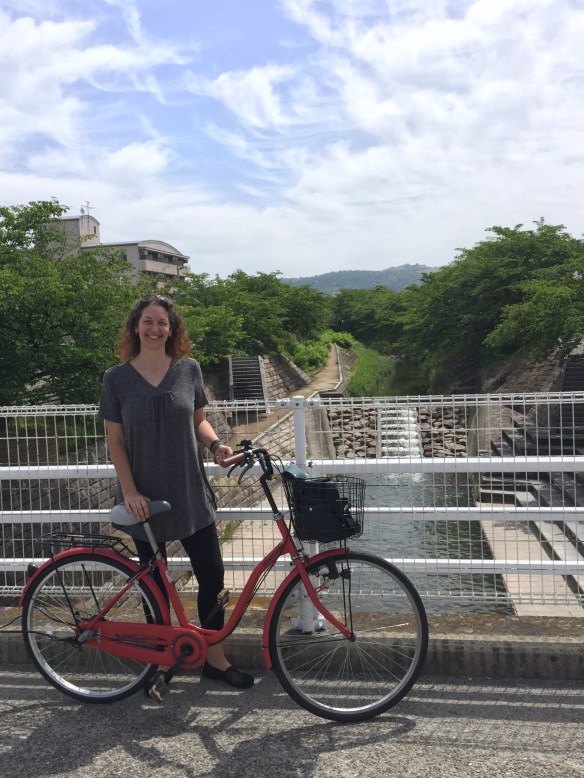
Saho River

For the rest of the tour, Hiro would stop around ponds and say we should get a photo here. Very sweet.

On the way to Nara Park, we rode through the small campus of the Women’s University, which was pretty quiet on this Friday. Our first stop in the park was Tōdai-ji temple, the site of the largest Buddha, or Diabatsu, in Japan. Hiro asked if I wanted to go in and said he would wait outside for me and that I should take my time.

I paid the ¥600 admission fee and entered the grounds along with many, many other tourists. A long pathway with grassy lawn on either side leads to the Great Buddha Hall, or Daibutsuden, so you get a nice view of it from a distance before you make your way to enter.

The Great Buddha is 49 feet tall and elevated on an elaborately decorated platform, so is thus quite impressive. Nonetheless, my first thought was that the Daibatsu in Kamakura may have “second” status due to being 44 feet but I liked it better. The patina over the bronze, the open-air setting, and its serene repose endeared it to me. Which is not to say I didn’t enjoy seeing the one here. I took the Hall’s circular path that goes around and behind the Great Buddha, past smaller Buddhist statues and display models of the temple’s buildings, former and present. All in all, I spent about 40 minutes on the site.

Upon exiting, I caught sight of my first deer! I found Hiro and we rode around the pond in front of Tōdai-ji, pausing for photos 🙂 We were about to ride uphill when we came upon two deer on the grass just off the pedestrian and bicycling path. We parked our bikes, and Hiro got out the rice crackers that I would have purchased myself if not on the tour but which he included in the Experience.

One of the does was shy and didn’t approach me at all, and the other was quite happy for me to feed her the crackers. I broke the round, flat crackers into pieces and held out my hand for her to eat from. In between each handful, she bowed her head up and down to ask for more. I asked if the deer in this park were trained to do that, and Hiro said it’s natural. In addition to feeding her, I wanted to pet her but she wasn’t so into that. Hiro said there are deer up higher in the park that are less shy.

There were some bathrooms on the other side of the path and I thought I should take advantage. Inside, I found 4 stalls, all of which were squat toilets. In my experience in Japan thus far, bathrooms have been either all Western toilets or a mix of Western and the traditional squat type. This was my first time having no choice but to squat. I was mostly fine with it, my biggest concern being splash potential, like when you’re in the woods.

Before we moved on, I asked Hiro about the mix of toilet types and learned that when he was young 40 years ago, there were only squat toilets in Japan. Over the last few decades, Japan has gradually transitioned to Western toilets, both in new construction, which is cheaper to install than squat drainage from a plumbing perspective, and in conversion, which is expensive. So buildings that haven’t been converted yet are both old and in places without a budget to change them. I asked if older people prefer the squat toilets they grew up with, and he said no because they are much harder to use for older folks!

I also asked if there is any resentment among the people that Japan has been Westernized in this way, and Hiro didn’t think so. This question about international relations led to a discussion about politics in general, and I really appreciated the one-on-one dynamic and Hiro’s openness that allowed me the opportunity to better understand Japanese culture.

We got back on our bikes and rode uphill through Nara Park to Nigatsu-dō Hall, which is part of the Tōdai-ji temple. It has a large balcony overlooking the park and the city of Nara, and Hiro brought me up there to show me the view and share some Nara history and culture. I learned that Nara was the capital of Japan for about 80 years in the 8th century, until the emperor moved to Kyoto; traditionally, where the emperor lives is considered the capital. And I learned that the balcony we were standing on is lined with monks bearing large torches during a two-week fire festival every March.

While we were chatting, I was approached by two schoolgirls who were maybe 10 or 11 years old. They practiced English phrases from their workbook and asked me to write in the country I’m from. It was so precious, I was on the verge of tears as I wrote in each of their books, and then they each handed me an origami crane! My heart was full.

From Nigatsu-dō, we rode our bikes down to Kasuga Taisha, a Shinto shrine dating back as far as when Nara was the capital. Hiro rang a gong and prayed. When I asked about the significance of the gong, he said it’s like saying to the gods, “Hear my prayer.” The shrine grounds feature thousands of stone lanterns, which Hiro said are lit each year on August 15 in honor of the dead.

On the main path through the lanterns, we found many deer 🦌😍. Hiro was right.. they were less shy here. In fact, they were rather aggressive! One doe bit the hem of my T-shirt and a male repeatedly poked me with his antlers, both of them wanting morrrre crackers. I fed them the rest of what I had, and just before we left the park, we encountered a calm and restful doe who allowed me to crouch down and pet her. So cool.

On our way out of the park, we stopped at Ukimi-dō Pavilion, a hexagonal gazebo overlooking Sagi-ike Pond, where I watched turtles and koi in the water.

At this point, we were well past the end of the scheduled tour as it was to go until 11:30 and it was after 12:30. When the morning tour ends, Hiro will often suggest to his group some additional spots and tell them where to return their bikes when they’re done. If he is able, he’ll join them. Today, Hiro had no mid-afternoon group from 12:00 to 14:30 and didn’t mind continuing to show me around Nara. In fact, he had a specific place in mind. He asked if I wanted to go sake tasting! I had tried sake many times, both hot and cold, and never really took to it. I suspected, however, that tasting sake in Japan would be a different experience.

We rode to Harushika Sake Brewery and each paid the ¥500 fee, which includes a souvenir tasting glass. In the main room, 4 or 5 wooden tables with stools surrounded a center area with staff and bins holding the sake bottles. A tasting menu described the 5 sakes we would try. I asked Hiro if it would be in poor form to eat the remainder of my panini, and he discouraged that, which was a bit of a bummer as I could have used some food in my belly prior to sake sampling!

I didn’t think about it for long. I was soon enamored of each of the sakes. I loved, loved, loved all of them. They were all served cold, and all could pretty well be described as mostly dry with a hint of sweetness or fruit. Hiro asked one of the staff for a sampling of pickled vegetables. Tsukemono, or “pickled things”, are often served with rice. The cucumber, squash, and smoked squash brought to us in small plastic labeled containers with toothpicks were more specifically Narazuke as they were pickled in sake lees, the remains of the mash used for brewing.

I really wanted to bring home a bottle of sake, but I just didn’t have the space in my bags. I did get two tasting glasses, though. The ones we used during the tasting were clear, and the brewery allows guests to choose one of four colors for a souvenir. Hiro is a frequent guest and doesn’t take any glasses home with him, so I got to choose a second. Just as I had unexpectedly acquired a souvenir Mission Estate wine glass from Frank, my tour guide in Napier, New Zealand, I was very happy to bring home my small teal and purple Harushika tasting glasses as souvenirs from Japan.

We were both hungry, and Hiro had a bit more time before his next tour at 15:00. He rode us past Sarusawa Pond (last photo stop in front of a body of water!) to lunch at Bikkuri Udon, where I tried somen, a dish of cold noodles. They were served in a bowl of water, and Hiro instructed me how to fill my empty bowl: first choose from the plate of mushrooms, green onions, and nori; then add some of the cold noodles; then pour over the dipping sauce — tsuyu — but not so much that it becomes a soup.

A few doors down, Hiro showed me a sweets shop (I didn’t know it at the time, but researching it now, it’s called Nakatanidou). The corner of the shop had large plate-glass windows through which we could see some wooden barrels and mallets. It was 14:30, and Hiro was sort of stalling for time. He wanted me to see this shop’s famous mochi-making. Eventually, we had to get moving for him to meet his next group, but he showed me this video on YouTube featuring owner Mitsuo Nakatani, master mochi maker, particularly of the high-speed variety. Crazy!

We rode to a bike shop near Kintetsu-Nara train station, a different one than where we’d started but where I could turn in my bike. I hugged Hiro goodbye and thanked him profusely for showing me so much of Nara. He went super overtime with me, and I absolutely loved it. I wondered how much of my customized tour had to do with me being an Airbnb employee, though I had a feeling Hiro is a stellar host to all.

I rode the Kintetsu-Nara line back to Osaka and arrived at almost 16:00, and I was tired tired tired tired tired.

I laid down and began researching transportation to and in Kyoto. I also shared an Instagram story of my encounter at Nigatsu-dō Hall with the schoolgirls. I don’t know how Hiro ended up with my phone, but he had video’d the whole thing and I was so grateful.

It had been almost a week since my last Facebook photo post, which was of Bali. I hadn’t shared any of my Japan experiences yet. Little did I know between the volume of photos and the crappy wifi at my listing that it would take me 4 hours to assemble and upload posts for the first 4 of my 8 days in Japan!

Deciding where to go for dinner was easy. I had a recommendation from Hiro for, of all things, Japanese-Italian. He said he and a friend regularly visit Saizeriya because it’s cheap and tasty. I’d tried a lot of authentic Japanese food, and I was tired and didn’t mind “cheating” by getting Italian because it was *Japanese-Italian* and because it was recommended by a local! Also, there were a few locations in Osaka, including about a 4-minute walk from the listing.

I was running low on cash and was really hoping to skate by on a credit card until tomorrow, but alas, a sign immediately upon entry informed me that Saizeriya, like seemingly everywhere in Japan, is cash-only.

I walked back down from the fourth floor to the street and looked up nearby ATMs, except I searched “bank”, thinking if I found a bank ATM, it might not carry a fee like a convenience store ATM would. There were two “banks” nearby, but they ended up being electronic kiosks of some kind that did not dispense money, or at least did not look like machines I should put my debit card in.

I searched again for ATM and found that the nearest was downstairs in the Kintetsu-Nippombashi subway station. I found “Seven Bank”, with a similar logo to 7-11 stores. Aaaaand it carried a fee. Ah, well.

It was 22:00 by the time I arrived back at Saizeriya. The host thankfully spoke enough English to ask if I wanted smoking or non- (such a throwback!). I was seated in a booth and then left alone for a suspiciously long time. No water, no menu.

Or so I thought. As I waited, my gaze wandered and eventually landed at the end of my table, where there was silverware, a menu, and a buzzer/bell thingy. A-ha!

Hiro had recommended the escargot — not feeling it — and the pasta with squid ink.. sure, OK. Spaghetti “Nero di Seppia” it is. And wine.

I pushed on the ringy-dingy, and a server appeared immediately. I pointed at the menu to place my order and finished with “Omizu, kudasai?” This means, “Water, please?” I was directed to a self-serve station at the back of the restaurant. It is very DIY here.

Seated with my water, my food also arrived very quickly, along with the bill. That would be the last I saw of any staff until I brought my bill to the front desk/hosting station to pay. In a country without tipping culture and in cities with millions of people, this efficiency makes total sense.

The wine came in a mini-carafe, far more than I was expecting. The spaghetti was very, very dark green, almost black. It tasted about as I expected it to, with a mild and not overpowering fishy flavor. I had far more wine than food, and I sat until I’d enjoyed all of it.

Hiro wasn’t kidding about cheap. The pasta was ¥499 and the wine ¥200. Together, the meal cost about $6.40 USD.

Back at home, I wanted to be productive with money stuff or journal writing, but I was slightly tipsy and very tired. After some random Internet time, I slept at 11:45.
Osaka: rest day / Dotonbori

I didn’t wake up until 8:00! I was happy to sleep past 5:30, 6:30, and 7:00. This was very likely due to the cave-like nature of this apartment. I got up and opened the curtains and realized there was no use in that; the building is very close to the next one over and very little natural light comes in (plus, not so much with the privacy, either).

Today’s first order of business was laundry (I last had it done in Bali 9 days ago). I spent a solid hour figuring out how to use the single washer/dryer appliance. The detailed house manual provided by my Airbnb host showed “on” and “start” only. I also needed to know how to use the gel packs, and it’s a good thing I looked that up as I would have placed them in the detergent cartridge, when actually they go in the washtub. With this very helpful post and holding Google Translate up to the machine, I figured out what 9 of the 13 buttons were for!

As in New Zealand, I sorted my clothes into tumble dry and hang dry loads as there was a drying line out on the small balcony. I started with the tumble dry load so I could see if the combination washer/dryer went all the way through both cycles automatically.

Breakfast consisted of three of the five black eggs from Ōwakudani, eaten one at a time every so often. I got out my laptop, alternately writing journal entries and getting the laundry done. When the first load finished, the dry cycle did not start right away, but I had learned enough about the kanji on the buttons to toggle through the cycle options using the “courses” button, landing on the dry-only cycle (please please please don’t start washing all over again…). The dry cycle runs in 30-minute increments. After the first, the clothes didn’t feel much more dry. After the second, they were dryer but definitely not dry. I moved them out to the drying line temporarily as I wanted to start the hang dry load. I figured the sooner I get laundry done, the more time all the clothes have to dry before I check out in two days.

There was only one gelpack left, so I needed to go buy more. I looked up convenience stores, and there was a Familymart around the corner and a Lawson (another chain I see a lot) a couple streets over. I didn’t want to be gone long, and I put on flip-flops and carried the bare minimum with me, just my wallet and the key. As I walked downstairs and outside, I couldn’t believe I’d left my phone behind, not only in the way we always feel naked without our phones these days but because I had no translation with me!

I tried the Familymart first and had success pointing to the empty container I was carrying and pointing to the aisles. The clerk showed me the laundry section and gestured to a couple products. Even though I had no idea what any of his Japanese words meant, I knew he was saying, “Sorry, this is the closest we have to what you’re looking for.” I wanted to buy an exact replacement, so I walked to the Lawson.

I stopped at the entry as the store was a bit bigger and I wanted the clerk to see that I was bringing in my own empty container. She was busy, though, and I gave up and went in. I found the same product and counted out the money I needed before approaching the counter (a habit I’d gotten into everywhere in Japan).

The clerk rang up the new box of gelpacks and gestured to the empty box under my arm. Again, I didn’t know her words, but I knew she was asking, “Is that yours?”, and I shook it to show it was empty and she laughed in a friendly way. Despite my frantic waving that I didn’t want a bag, she bagged up the new box. I’ve been surprised, as in Bali, how much plastic is used here.

I returned to the apartment and realized it’s a really good thing I’d memorized the callbox door code as I didn’t have my phone to look it up and the key is for the apartment only. Note to self: always bring phone.

I washed the second load and then switched out the clothes on the balcony, hanging the newly washed clothes and moving the tumble dry back inside for one or two or three more cycles.

I was uploading the detergent receipt to the Airbnb resolution center, where users can request or send money to each other (it was less than $5 USD, but detergent is for the host to provide) when the pocket wifi faltered. I switched to tethering my phone as I’d done on the shinkansen yesterday, and almost immediately received two consecutive texts from T-Mobile, the first that I was at 80% of the data pass I’d purchased two days ago, intending for it to last ten days, and then a few minutes later that I was at 100%.

Somehow, switching between the bad wifi and the throttled data, I was able to complete submission of the receipt. The new task, then, was to log in to T-Mobile to buy another pass. But I couldn’t reach T-Mobile either on wifi or with my phone’s limited data.

I composed a message to my Osaka host, not knowing how I was going to send it, that if a listing says it has wifi, then continuous access is expected. If pocket wifi with limited bandwidth is the only option offered, then the listing does not meet the criteria for offering wifi as an amenity. I don’t reveal that I’m an Airbnb employee when I book listings as a guest because I want the same treatment as any guest. I did so here, though, in the context of establishing that I know what I’m talking about. I let her know that I would be sending a second reimbursement request for additional data from T-Mobile as a result of the listing’s wifi being unusable. By turning off wifi, my phone had enough cellular data to send messages, via both iMessage and the Airbnb app.

The host responded quickly and was confused about both pieces of my message, first the detergent reimbursement request; she said the cleaners should have stocked the apartment with detergent.. I replied they did not. She said the pocket wifi refreshes every other day and should be usable again soon; even if that were true, that is not continuous access. She didn’t understand why I would be sending another reimbursement request regarding wifi. I reiterated that the pocket wifi is insufficient for a listing that says it offers wifi. I explained that I had been traveling for four weeks with very few rest days and planned to explore Dotonbori tonight but I had hoped to have an Internet catch-up day in the listing and it wasn’t working out very well. She understood and said she’d get back to me.

In the meantime, I lost count of how many dry cycles I ran the clothes through in the machine, pulling out items that were finished drying every 30-minute cycle until all of them were done. I’d hardly done any blog writing, my main purpose in taking a down day.

Despite the messages from T-Mobile, tethering my phone data to my laptop seemed to be working well enough, and I spent another few hours writing a post for my first full day exploring Tokyo. When I finished around 17:00, I felt totally gross about having spent a beautiful day in a city I’d never seen indoors on my computer, which might be OK if I actually felt caught up, but I was still 5 days behind in journaling and I hadn’t posted any photos anywhere. Time to go out!

Besides takoyaki, another signature dish in Osaka is okonomiyaki, a savory pancake both topped with and made from batter with eggs, vegetables, shrimp, and/or meats. ‘Okonomi’ means ‘as you like it’ and ‘yaki’ means ‘grilled’. With my slow-ass wifi, I looked up a good place nearby to try it and, thanks to this post, settled on a family-run place in Dotonbori called Mizuno.

Dotonbori is a brightly lit and colorful promenade of shops and restaurants along a canal and arguably the sight to see in Osaka if you had to choose only one. I’d booked this Airbnb largely due to *all* the reviews saying what a great location it is, being a 5- to 10-minute walk from multiple train stations as well as Dotonbori.

It was dusk when I headed out toward the canal. There are walkways at canal-level on either side of the water, and Dotonbori Street runs parallel to the canal on the south end. I followed Google Maps to Mizuno just off of Dotonbori Street. Romanized names are not always present on storefront signs, so I looked for a long line instead. Found it!

There are many ways to order your okonomiyaki. While waiting in the queue outside, I was presented with a laminated sheet showing Mizuno’s top 5 options, all of which either had meat or didn’t sound so appealing to me (fried yams, fried cabbage). When I got closer to the door, I asked a staff member for an English menu and was thrilled to discover the vegetarian option with eggs, mushroom, and green onion. I love all these things.

After about 20 minutes in the outside queue, I was shown through the front door and onto a set of about 5 stairs to wait some more. I could kind of see into the dining/kitchen area, and as I climbed the stairs, I got a better look and realized that my view had been of a mirrored wall, so the restaurant was much smaller than it first appeared. There were 9 seats in front of the grill.

I moved off the stairs and onto a bench against the wall across from the grill and waited a bit more (much like my ramen experience in Tokyo). I was seated in the last seat at the grill away from the front door after waiting about 40 minutes total. In front of me were placed a steel spatula, chopsticks, a small plate, a glass of water, and of course a wet napkin for hand cleansing before eating.

I wondered how the cooks would know which order was mine and worried for a moment that I would need to try to communicate with them, but instead my okonomiyaki was already in progress. The batter at Mizuno is made with flour, egg, Japanese yam and a dashi broth, and the mushroom, onion, and egg were already cooking with the pancake. There was a bit of communication to achieve the ‘as you like it’ part: yes to mayonnaise, yes to mustard, regular and not sweet okonomi sauce (like worcestershire), yes to bonito (fish) flakes, and yes to green tea powder.

Looks like:

Okonomiyaki

I cut off about a third of the pancake, which filled the small plate. Its height means there is more food than is indicated by the circumference! It was super yum, and I ate slowly to savor it but not so slowly as to be inconsiderate of folks waiting behind me. Along with ramen at Ichiran and sushi at Hashiri, another unique dining experience found in Japan!

I thought there were a lot of people on Dotonbori when I arrived for dinner, but afterward, it was absolutely packed. I wandered west, coming upon the second most famous icon on the street, the giant crab above Kani Doraku restaurant. I kept going until I hit what seemed to be the natural western border of the district, Midosuji Street, and turned right toward the canal. I was just wondering when/how I would encounter the canal’s most iconic sight, the Glico running man, when I stepped onto Dotonbori Bridge, looked down the canal at the view, and there he was.

Glico

This advertising sign showing a runner in a victory pose was first installed in 1935 and has been changed 5 times, most recently from neon to LED bulbs. Not even the locals understand how the sign became so famous.

I walked down the steps to the north side of the canal and took photos along with the other tourists. I went back up to the bridge because I decided I wanted a photo of myself in front of the canal. Glico man or not, I loved all the brights signs reflecting on the water.

That’s when I spotted a Don Quijote across Midosuji Street. “Donki”, as the locals call it, is a discount chain store. I was vaguely aware that I needed to check out a selection of Kit Kats while in Japan as they come in a variety of flavors, some fruity, some more savory, like red bean and matcha. I’d read somewhere within the last few days that I’d be able to do that here. And I wanted to bring home some treats for my team at work.

I crossed Midosuji and walked in to Donki and was immediately overwhelmed by all the people, the goods, and what felt like an assault of pink. There was just a lot of… stuff. I walked around the “aisles”, which makes the place sound orderly. It was more like a cluster of shelves here and a cluster there. I perused the liquor and sake in the back but I was there for the candy.

I considered buying a ginormous bag of Haribo gummy bears, but it was like $20 USD! I was also very short on space in my backpack. I found the Kit Kats and was a bit disappointed not to see anything too crazy. There was raspberry, but I went for a bag of the matcha as it’s more unusual and very Japan.

I crossed Midosuji again and gestured to a photo-taker to ask if he would take mine in front of the water. It didn’t come out so well, so I hung out a bit, waiting for some English-speaking tourists to come along and start taking photos so I could ask to trade. The female half of a couple I asked next had some practice at getting photos right, which she said was because *he* was so particular, pointing to the other half 🙂

I took the steps back down to the canal and then up to Ebisu Bridge, where photo subjects practiced their best Glico running pose, with the sign behind them. The north side of the bridge led to the entrance to Shinsaibashi shopping mall, which simultaneously looked to me like an Osaka sight to see and a hellmouth. Pass!

I continued back down to the canal again on the south side, coming upon a small cafe with tables and chairs outside. The drink menu included mulled wine, which, though it was not an autumn night and not chilly, sounded good. I was tired, though, and decided to keep walking along the canal until I reached the street where I’d entered Dotonbori earlier.

I went up the stairs to street level and almost crossed Dotonbori Street to walk home when I changed my mind. It was 20:30, and I had not yet quite gotten my fill of the sights. I decided to get that mulled wine after all.

I took a different route back to keep seeing new things.

I passed by an arcade with a large open window through which onlookers cheered on two people performing (seriously) with a Dance Dance Revolution type game. I was so happy I had come upon this scene and took some video, knowing it would continue to make me happy when I viewed it later, and somehow I managed to instead video the people standing next to me. I was pointing my phone ahead of me and occasionally glancing at the screen while recording, so I really don’t understand how this happened. Ah well, I have my memories (and this remembrance in writing).

I also encountered some quieter back streets behind Dotonbori, one of which was lined with Buddhist iconography: a recessed statue, some fountains, and a tiny bamboo and rock garden. Very peaceful. Another restaurant’s storefront featured a glass display case on one side of its stone facade, decorated with objet d’art, and on the other a glass enclosure through which a large fountain of wide bamboo stalks could be seen and heard. I just love this quality of Japan, the peaceful beauty.

I made my way back to the canal-side cafe and ordered the mulled wine, which turned out to just be red wine that was not mulled at all, which was fine. At the next table over, one of two women had also ordered the mulled wine and found it not be be mulled.. haha. I struck up a conversation with them by guessing their accent placed them from Manchester. That was too specific, but they were indeed from North England.

I drank my wine leisurely and walked back to the listing around 22:00, satisfied with my extra jaunt. I got in bed with my laptop and went to sleep around midnight.

Hakone -> Osaka

The trend of waking up earlier each day continued … 5:30 today! I successfully rolled over for another hour plus and got up at almost 7:00.

I did a full set of stretches and put on my yukata to go down to the shared onsen space. The layout was similar to last night’s private onsen. First is the changing room, this one shared with other guests, which leads to a large room with a shower area, indoor hot pool for soaking, and a sauna. From there, a door leads out to the large open-air hot bath. It was overcast and slightly chilly, which was not an issue once I got in the outdoor pool. I soaked there for a bit, sat for not even 5 minutes in the sauna because goddamn, and then took a soak in the indoor pool until it was time for breakfast at 8:00.

On my way from the spa to the dining room, I passed by the family of three talking with someone in the lobby and overheard the father say they’re from New York. Ah! Of course they are. (Sorry, Francesca!) I’d gotten a whiff of the entitlement that comes with money, and being New Yorkers also made sense. I didn’t hold the delay in my hot stone appointment last night against them and let them know this by way of saying, “Good morning,” which the father returned. I did hope the mother was surprised by that.

Unlike the nine-course dinner last night, all of breakfast was served at once and was waiting for me when I arrived at my table, the same one from last night. While just one course, it was still a whole lot of food. There was a filet of salmon, small quiche, soft tofu heated in a bunsen burner type contraption, firm tofu, rice, pickled vegetables, fresh vegetables, and yogurt with fresh mango.

As I ate, I used my phone to make a plan for the day, checking both the weather and the train schedules. I thought I was going to have a leisurely morning, check out at 11:00, and see the sights on the remaining legs of the Hakone transportation circuit, but here I had a bit of an “oh, shit” moment.

Thing I did not anticipate #1: The shinkansen from Odawara to Osaka only runs every two hours. There was already no way I was going to catch the 12:08, so I worked backward from the 14:08 and realized I would need to get a move on, as well as likely skip some of the sights I’d planned to see. It was 2.5 hours on the shinkansen to the main station of Osaka, and I would need to transfer from there to the subway and then walk to my Airbnb. I wanted to arrive before dinner as the day was already going to be pretty long.

I got back up to my room at 9:00 and began getting ready to go. Except.. what’s this.. oh dear.. yep, that meal is going right through me again. I remain in the dark as to whether this was a healthy or unhealthy response by my body to what I ate. What I know is that it gave me a legit opportunity to take advantage of the Japanese toilet’s rear spray for bum cleaning! 💩

I also showered. I packed everything up and went down to the podium to check out, returning the iPhone charger. I paid the ¥35,790 I owed with a credit card. At the exchange rate on that day, this was $328.50. Expensive for one night, yes, but worth it to me for the whole experience.

I left the ryokan a bit after 10:00 and walked to Gora Station. The next cable car (or funicular to me, since I learned what that is in Barcelona last year and this was one of those) would depart at 10:21 and they run every 15 minutes. I had wanted to see Gora Park a few blocks away (it has a fountain!), and I started to walk up the hill toward it. I didn’t get far before I thought better of this idea and headed back to the station to be on that 10:21. I had a feeling my connections today were going to be pretty tight.

The funicular ends in Sounzan after about 10 minutes, during which time I chatted with my seatmates, a friendly older couple from outside London. There are no sights in Sounzan that I know of; I believe the vast majority of visitors connect directly to what Hakone calls a ropeway and what I think of as a tram. Each tram car seats 18 passengers, and the cars turn right around when they arrive, like ski lifts, so no problem with that connection.

It’s an 8-minute ride to the first stop, Owakudani, and just before arriving there, the tram goes over a sloped mountain face with sulfurous (read: stinky) steam rising from it. This is the source of the hot springs in which I soaked last night and this morning.

I had planned to hike the Owakudani Nature Trail and buy the town’s infamous black eggs along the way. The eggs are boiled in the volcanic waters and are said to extend one’s life by seven years. I don’t know about that, but I like eggs. Unfortunately, the trail was closed for a month beginning today due to volcanic activity, and really I would not have had the time in any case.

It was not only the trail, but the rest of the tram journey to Ubako and Togendai was closed as well. The first of four Mt. Fuji viewing points along the Hakone circuit is on the tram between Owakudani and Ubako; even if the tram were open, it was starting to rain and the gray skies were not going to allow a view of Fuji, rather a bummer after yesterday’s perfect blue skies.

I was happy to find that I could still buy black eggs in the Owakudani gift shop. They were super cool-looking! The black on the surface comes from the sulfur and iron in the volcanic waters, but it doesn’t dye the egg uniformly. They looked dip-dyed, and the effect made little galaxies on the shells.

I made my way to the substitute shuttle bus from Owakudani to Togendai. As I was getting off the bus, I thought I kinda wanted to use the loo but also thought it was better to keep moving and making my connections, and I didn’t have to go that bad. And then I stopped in the loo anyway.

Thing I did not anticipate #2: The boat across Lake Ashi only runs every 40 minutes. I approached the ticket and boarding area at 11:20, and the ship was leaving at 11:20. If I hadn’t stopped to use the bathroom, would I have caught it? I don’t know, but I had worked out when calculating backward that I needed to get off the boat at Moto Hakone and catch the bus to Hakone-Yumoto Station at 12:33, and the next boat was at 12:00 and would arrive at port at 12:40, too late to catch the bus I needed.

So I had nothing to do for 40 minutes but stress about my connections for the rest of the afternoon. I really did not want to have to kill two hours at Odawara Station waiting for the 16:08 shinkansen. That would suck, and I wouldn’t get to my listing in Osaka until about 19:30. I waited at the front of the line for the next boat until it was time to board.

The boat was a replica of an English man-of-war and looks like a pirate ship, which was very charming. Despite trying to switch gears and enjoy the ride across the lake, however, between the drizzly weather and the transportation stress, I was unsuccessful.

The first stop across the lake was Hakone-machi. My original plan was to disembark here and see the Hakone Checkpoint, built in the 17th century as a guardhouse and lookout tower along the old Tokaido Highway during the feudal Edo period, while walking to the other port, Moto Hakone. Instead, I stayed on the boat to get to Moto Hakone faster.

Things looked up when the next available bus turned out to be an express to Hakone-Yumoto Station, but we still arrived just in time to miss a train to Odawara. The next train would get me to Odawara with a 15-minute window to exit the train area on the second floor, take the escalators to pay for and retrieve my luggage from the lockers on the ground floor, and get back up to the shinkansen platforms on the second floor with all my stuff.

I bought a bento box with shrimp onigiri at Hakone-Yumoto since I would not have time to grab food at Odawara before boarding the bullet train. I rode the train to Odawara anxiously, and as we approached the stop, I stood in front of the doors with my backpack on, ready to sprint.

The doors opened, and I popped out like a track runner that just heard the pistol. I huffed and puffed through the terminal and down both a set of stairs and an escalator to the lockers (2 minutes). I had memorized the PIN to open my locker and used the touchscreen to enter it, but it didn’t work. I pulled the receipt from my wallet and checked to make sure I had it right and tried again. Same error: There is no locker matching this PIN. I looked over at the locker with my stuff in it — wrong number. I was in the wrong bank of lockers! I moved down one and used that touchscreen, which accepted my PIN and requested the additional ¥500, which I had ready. I pulled all my stuff out, with no time to sort it and re-organize it into the backpack and carry-on. I stuffed everything not in the carry-on into the backpack (4 minutes).

I ran back to the escalators with 9 minutes left. I had to decide whether to try a non-reserved car on the shinkansen or risk the amount of time it would take in the ticket office to reserve a seat. There was only a very short line, so I tried the ticket office, keeping my eye on the time and ready to bolt if getting a seat wasn’t going to happen. At 14:04, my turn was up and I showed my prepared request in the Google Translate to the agent. He was on my side and kind of chuckled as he rushed to book my seat and print the ticket. Thank you, sir!

I sprinted out of the office and up one more escalator, arriving at the platform with 2 minutes to spare. The bullet trains run exactly on time, and they do not wait at the station very long (as each stop is announced, passengers are reminded to gather their belongings in advance of the stop and be ready to exit). The train pulled up, I got on, and we were off at 14:08. I had skipped Gora Park, the Owakudani trail, and the Hakone Checkpoint and still barely made it, but at least Operation GTFO of Hakone was a success!

From Odawara to Osaka would be 5.5 hours by car and is 2 hours and 20 minutes on the shinkansen. I thought this would be a good chunk of laptop time, but I spent the first hour eating my onigiri, browsing on my phone, and generally calming down. I did pull out my laptop and realized I couldn’t save anything I was writing with no Internet (I was surprised to find that wifi on the shinkansen is either non-existent or paid). I tethered my laptop to my phone, and that worked surprisingly well.

We arrived at Shin-Osaka Station just before 16:30 as scheduled, and I made my way through the station to transfer to the subway. While I was able to make my way around Tokyo on the JR Pass and without buying a Suica card for the local metro, I for sure needed to buy a Kansai transportation pass; that’s the region of Japan where Osaka and Kyoto are located, and the ICOCA pass is good for all modes of transportation in both cities.

Using a ticket terminal, I didn’t see an option for ICOCA, so I bought what was called a multi-use pass for ¥3,000 ($27.25 USD), thinking that must be the same thing. It was a 22-minute ride south to Namba Station, and along the way I suspected I had purchased the wrong pass. I had a feeling it was good in Osaka only, in which case I wasn’t nearly going to get my money’s worth and would need to buy another pass in Kyoto.

At Namba, I approached a station agent. Through a bit of back-and-forth using Google Translate, he told me, to my surprise, that I could get back on the subway to Shin-Osaka and approach the agent booth there to get a refund, even though I’d already used the ticket to leave Shin-Osaka.

I was so tired that I thought maybe I’ll try that tomorrow. I approached the gates to exit, and he shouted at me, not in a stern way but in a protective way, like he wanted me to be able to get my money back and get the right pass. I don’t know what other people would do in this situation. Though not a lot of money, I really didn’t want to eat $27, or whatever portion of the funds I wouldn’t be able to use. I wanted the right pass. I thanked him and headed back to the trains.

I got on the next train going toward Shin-Osaka and browsed on my phone to pass the time that I was not spending walking to my Airbnb listing, where I could get settled and get some food. So I did not notice when the entire train emptied one stop before Shin-Osaka. A stranger angel poked her head back in the car, got my attention, and gestured for me to get off the train. I looked around in shock that I was alone on the car!

I stepped off and waited with her on the platform for the next train, using Google Translate to thank her for “saving” me, at which she smiled. I noticed pink signs behind us on the wall and at our feet designating this section of the platform as Women Only. I pointed to the sign and gave her the thumbs up. I was feeling some solidarity with this young woman. When we boarded the car, I realized the Women Only platform was to board the Women Only train car. Fuck yeah, Osaka!

True to the Namba agent’s word, a Shin-Osaka agent gave me a full refund for my multi-pass without any hesitation. That was nice. I still didn’t know where to buy the ICOCA pass, though. When I asked, I was led out of the agent booth past the first set of ticket terminals I’d used and around a sneaky corner to another set of terminals that offered the ICOCA pass along with the other types. I bought the correct pass for ¥2,000, ¥500 of which is a deposit. Much better.

It was a little after 17:30. I’d lost about an hour. I waited a bit for the next train toward Namba, rode to Namba, and exited the station into the busy, busy corridors of my listing’s vibrant neighborhood. At this point, my back was aching from my bags and I was very tired from the long day. Thankfully, it was only a 7-minute walk and I found my listing fairly easily. The host had forwarded the self-check-in instructions in advance, and I retrieved the key from the mailbox and took the elevator up to the second floor of the large apartment building.

I walked in at 18:30 after 8.5 hours of travel by funicular, tram, bus, boat, bus, shinkansen, and subway. Whew!

The studio apartment was pretty spacious by Japanese standards. I unpacked and looked up where to get some dinner. One of Osaka’s signature dishes is takoyaki, dough balls cooked with bits of octopus, tempura, pickled ginger, green onion, and your choice of sauce. I found a review praising a place within a 10-minute walk for its cheap, plentiful, and tasty takoyaki.

I ordered 12 takoyaki balls for ¥450 and chose Osaka sauce, a lemon-mustard blend. I had planned to sit down, but I was thrilled when my order came in a takeaway box. I ate back at the listing and found the dish too heavy for me, plus I was sad for the octopus, though I was glad I tried it.

I showered and washed my hair and caught up on some blogging, writing and publishing a post about flying from Bali and arriving in Japan 5 days ago (sigh).

At 23:30, I slept.